
Why You Should Stop Weighing Yourself: 3 Better Ways to Track Progress
Written by John Solomou | Founder, Phoenix Wellness Team
Researched & Fact-CheckedPeer-Reviewed Clinical Literature (PubMed / NIH / ISSN)
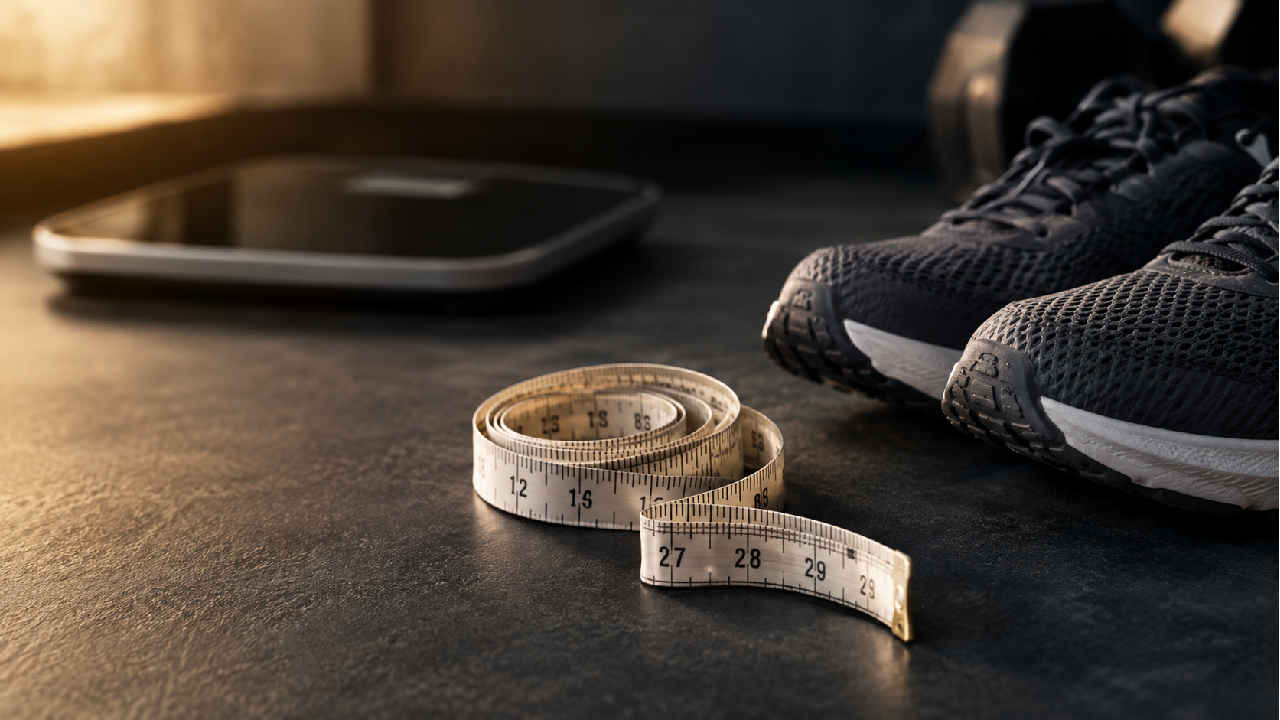
Why You Should Stop Weighing Yourself: The 3 Better Ways to Track Fat Loss and Muscle Gain
If you have ever eaten clean, walked 10,000 steps a day, and trained hard for two weeks straight—only to step on the bathroom scale and see your weight go UP two pounds—you know the exact frustration that leads most people to quit.
Here is the uncomfortable truth: your bathroom scale is an extremely poor tool for measuring physical transformation.
Relying solely on body weight to measure health and fitness progress is not only inaccurate—it can be psychologically destructive and actively derail your results.
In this guide, we examine why the bathroom scale misleads you, why high-tech body scans like DEXA aren't practical for daily tracking, and the 3 proven, objective methods you should use instead to measure real body re-composition.
---
3 Reasons the Bathroom Scale Lies to You
1. It Cannot Distinguish Fat Loss from Muscle Gain
A standard scale measures one metric: the total gravitational pull of your body against the floor. It cannot differentiate between: Adipose fat tissue Skeletal muscle mass Intramuscular glycogen stores Retained fluid and extracellular water * Bone density and food digesting in your GI tract
When you begin a structured strength or walking program while consuming adequate protein, you frequently experience body recomposition—simultaneously losing visceral/subcutaneous fat while building lean muscle mass. Because muscle tissue is significantly denser than fat, your physical frame shrinks, your waist tightens, and your health improves, even while the number on the scale remains completely frozen.
2. Daily Water and Glycogen Fluctuations Mask Fat Loss
Your body weight naturally fluctuates by 2 to 6 pounds in a single 24-hour window. These rapid shifts have zero relationship to fat gain or fat loss.
When you start exercising or increase daily activity, your body stores extra glycogen in muscle tissue for fuel. Every single gram of stored glycogen holds approximately 3 to 4 grams of water [1]. Furthermore, exercise creates microscopic tears in muscle fibers, triggering a temporary inflammatory response that holds fluid localized to the muscle group [2].
If you step on the scale during this normal adaptation phase, the scale will register a weight increase—even though you are actively burning body fat.
3. Scale Obsession Prompts Unhealthy Behaviors
Relying on a daily scale reading creates an emotional rollercoaster. A low number creates temporary validation, while an unexpected spike leads to panic, over-exercising, or aggressive calorie restriction. Extreme calorie restriction causes your body to break down lean muscle tissue for energy, slowing your resting metabolic rate and making long-term weight maintenance significantly harder [3].
---
What About DEXA Scans? (The Gold Standard Paradox)
Dual-Energy X-ray Absorptiometry (DEXA) scans are widely considered the clinical gold standard for measuring exact body composition. A DEXA scan uses low-dose X-ray technology to differentiate bone mineral density, lean soft tissue, and fat mass across individual body segments.
While DEXA scans provide exceptional clinical accuracy, they are impractical for routine, weekly progress tracking: Radiation Exposure: Although the dose is low (roughly equivalent to the background radiation of a commercial flight), performing DEXA scans frequently is neither necessary nor advisable. Cost & Accessibility: Scans typically cost $70 to $150 per session and require visiting a specialized clinic or mobile scan truck. * Hydration Sensitivity: Even DEXA scans can be thrown off by acute changes in muscle glycogen and hydration levels.
Save DEXA scans for an occasional baseline check (once or twice a year). For weekly tracking, simpler home methods work better.
---
The 3 Better Ways to Track Real Physical Progress
To get an accurate, stress-free picture of your body recomposition, ditch daily weigh-ins and adopt these three practical metrics:
1. Flexible Tape Body Measurements (The Most Reliable Home Metric)
Taking circumferences at key anatomical landmarks tells you exactly where you are losing inches and where you are gaining lean muscle.
How to measure: Waist: Measure directly at the navel (belly button) while relaxed (do not suck in). Hips: Measure around the widest point of your glutes. Chest/Bust: Measure at the nipple line across the fullest part of the chest. Thighs & Arms: Measure at the midpoint between joint bends.
Take these measurements once every 2 weeks under identical conditions (first thing in the morning, fasted, after using the restroom). If your waist measurement is dropping while your scale weight stays flat, you are successfully losing fat while preserving muscle.
📏 Precision Tracking Tools (Beyond the Scale) Ditch traditional weight scales in favor of metrics that measure actual lean tissue and body composition changes: Self-Locking Body Tape: Track true circumference changes across your waist, chest, and arms using a MyoTape or Renpho Smart Body Measuring Tape. As an Amazon Associate, Phoenix Fitness Pro earns from qualifying purchases.*
2. The "Anchor Garment" Test (How Your Clothes Fit)
Pick one non-stretching item of clothing—such as a tailored pair of denim jeans or a fitted button-down shirt—to serve as your objective benchmark. Try this item on once every 14 days. Pay attention to: How easily the waistband buttons without forcing it How the fabric sits across your hips and glutes * Freedom of movement across your upper back and shoulders
If your anchor jeans feel looser around the waist, your body fat percentage is dropping regardless of what any electronic device says.
3. Bi-Weekly Progress Photos
Human eyes adapt slowly to gradual daily changes, making it difficult to see your own transformation in the mirror. Standardized progress photos provide a clear visual archive of your structural changes over time.
Photo Protocol for Maximum Accuracy: Lighting: Use natural, indirect room lighting. Avoid harsh overhead lighting or dark shadows. Timing: Take photos every 2 to 4 weeks on a empty stomach in the morning. * Angles: Take 3 full-body photos: Front, Side, and Back. Keep camera height at chest level.
---
The Bottom Line
The scale is merely a tool that measures your total mass relative to gravity; it is not a judge of your fitness, health, or effort. By switching your focus to body measurements, clothing fit, and progress photos, you eliminate daily anxiety and track the metrics that actually matter: losing body fat and building lean, functional muscle.
If you are currently focusing on building muscle and burning fat simultaneously, ensure you are hitting your daily protein targets to support recovery:
👉 Calculate Your Custom Protein Needs with the Phoenix Protein Calculator
---
Frequently Asked Questions
How often should I take body measurements?
Take body tape measurements once every 14 days. Taking measurements more frequently can capture normal day-to-day fluid variations rather than true structural fat loss or muscle hypertrophy.
Can smart scales (bioelectrical impedance) accurately measure body fat percentage?
Home bioelectrical impedance scales pass a tiny electrical current through your legs to estimate body composition. However, these devices are notoriously sensitive to hydration levels, skin temperature, and recent meals. A single extra glass of water or a workout right before standing on a smart scale can alter the body fat reading by 3% to 5% instantly, making them unreliable for precise tracking.
Why do my waist measurements drop even when scale weight stays the same?
This occurs during body recomposition. Because skeletal muscle tissue is significantly denser and takes up roughly 18% less spatial volume per pound than adipose fat tissue, losing fat while retaining or building muscle causes your physical dimensions (waist, hips) to shrink while your total scale mass remains unchanged.
---
Scientific References
- Glycogen storage and its associated water binding in human skeletal muscle. American Journal of Clinical Nutrition / PubMed. https://pubmed.ncbi.nlm.nih.gov/7068293/
- Exercise-induced muscle damage, inflammation, and muscle glycogen synthesis. Journal of Applied Physiology / PubMed. https://pubmed.ncbi.nlm.nih.gov/8665277/
- Metabolic adaptation to weight loss: implications for the athlete. Journal of the International Society of Sports Nutrition / PubMed. https://pubmed.ncbi.nlm.nih.gov/24571926/
Editorial & Scientific Integrity Disclaimer: This article is for informational and educational purposes only and does not constitute medical advice. Always consult a qualified healthcare professional before starting any supplement regimen or dietary change. All physiological and nutritional claims are referenced against primary clinical research (PubMed/NIH) throughout the text. Some links on this page may be affiliate links.
Written by Phoenix Wellness Team
The Phoenix Fitness Pro team researches every article against current evidence and real member experience so you get practical guidance, not hype.
Learn more about Phoenix Fitness Pro