
Why Exercise Makes You Healthier: 7 Science-Backed Reasons
Written by John Solomou | Founder, Phoenix Wellness Team
Researched & Fact-CheckedPeer-Reviewed Clinical Literature (PubMed / NIH / ISSN)
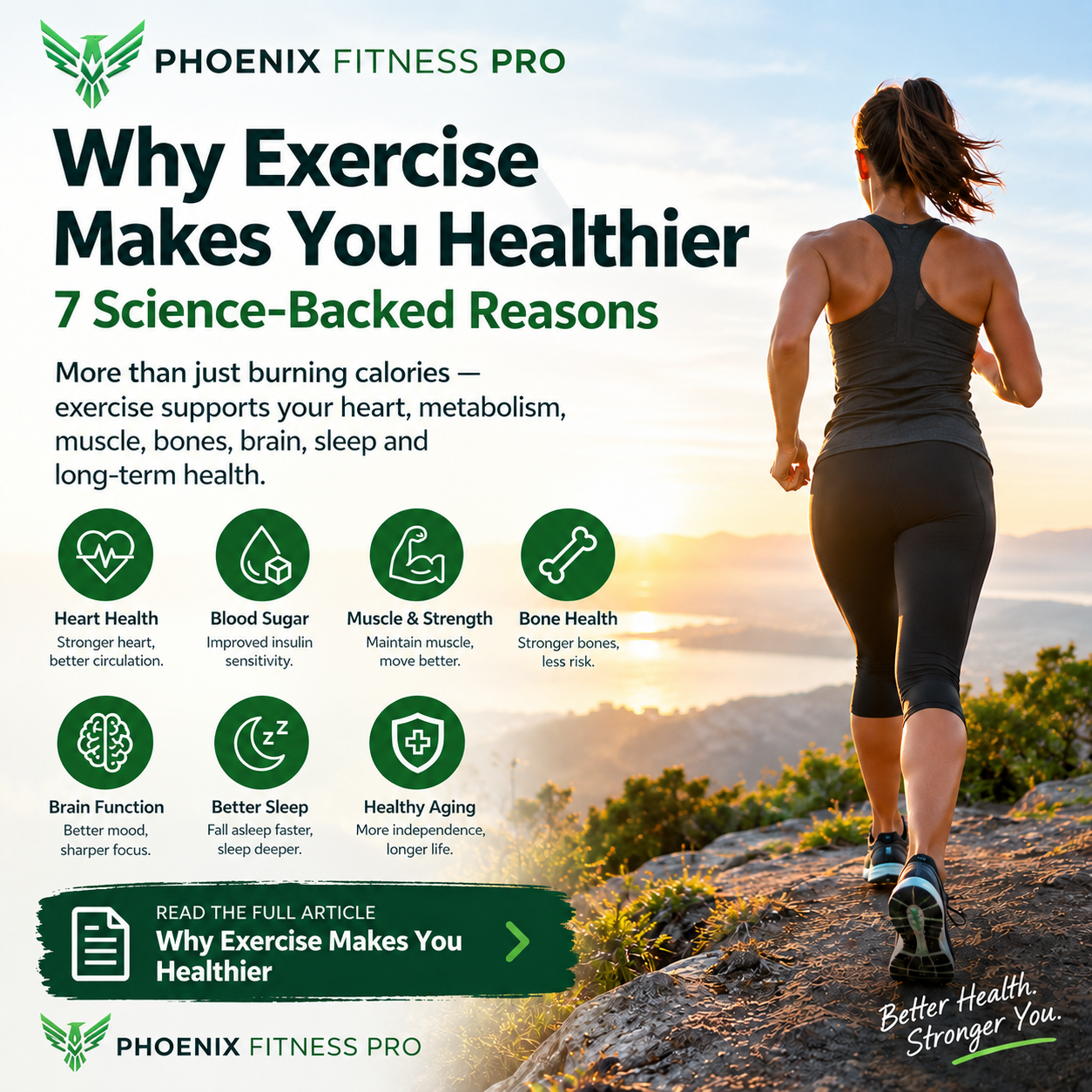
Why Exercise Makes You Healthier: What Happens Inside Your Body
Exercise makes you healthier because it trains your body to handle physical stress more efficiently. Your heart pumps blood more effectively, your muscles use glucose more readily, your bones respond to loading, and your brain benefits from changes linked to mood, sleep, and cognitive health. Over time, regular physical activity is associated with a lower risk of cardiovascular disease, type 2 diabetes, and premature death.
These benefits extend well beyond weight loss. You can improve your health even if your body weight stays the same, your workouts are short, or you never set foot in a commercial gym.
For adults over 35, exercise also becomes an important way to maintain strength, physical independence, and the ability to keep doing everyday activities as the years pass. The goal is not to train as hard as possible. It is to give your body a consistent reason to adapt.
1. Exercise Strengthens Your Heart and Blood Vessels
Your heart is a muscle, but its response to exercise goes beyond simply becoming stronger. Aerobic activity challenges your cardiovascular system to deliver oxygen to working muscles. With consistent training, your body can become more efficient at transporting and using that oxygen.
Walking briskly, cycling, swimming, rowing, and other sustained activities can improve cardiorespiratory fitness. Depending on your starting point, training may also help lower resting heart rate and improve blood pressure.
Your blood vessels matter, too. They must expand and contract appropriately as blood flow changes. Regular physical activity supports vascular function and can improve several cardiovascular risk factors.
A large dose-response meta-analysis of prospective studies found that greater amounts of non-occupational physical activity were associated with lower risks of cardiovascular disease and premature death. These findings come largely from observational research, so they cannot prove that exercise alone caused every difference. However, they align with controlled research and established physical activity guidelines.
The practical takeaway is straightforward: you do not need to run long distances to work on cardiovascular health. A brisk walk that raises your breathing rate can be a useful starting point.
2. Exercise Helps Your Body Manage Blood Sugar
Your muscles use glucose for energy. When you exercise, working muscles increase their demand for fuel, and muscle cells become better able to take up glucose. Regular activity also improves insulin sensitivity, meaning your body may need less insulin to move glucose from the bloodstream into cells.
This matters because poor insulin sensitivity can contribute to elevated blood sugar and the development of type 2 diabetes.
Muscle contractions can stimulate glucose uptake through pathways that do not rely entirely on insulin. After exercise, muscles may also remain more responsive to insulin for a period of time. Repeating this process through regular activity helps support healthy glucose regulation.
Strength training adds another benefit: maintaining or building muscle gives your body more tissue that can use glucose. Aerobic exercise and resistance training work through overlapping but not identical pathways, which is one reason combining them makes sense.
Exercise is not a guarantee against diabetes, and genetics, sleep, nutrition, medication, and other factors also matter. But regular physical activity is one of the most useful habits for improving metabolic health.
3. Strength Training Helps Preserve Muscle, Bone, and Independence
Muscle does more than move your body. It helps you climb stairs, carry groceries, get up from the floor, maintain balance, and perform the physical tasks that make independent living possible.
Adults naturally tend to lose muscle and strength as they age, particularly when activity levels fall. The rate varies widely, and age alone does not determine how strong someone can become. Resistance training gives your body a reason to maintain and build muscle.
When you challenge a muscle with an appropriate load, you create a stimulus for adaptation. With sufficient recovery, food, and repeated training, muscles can become stronger and may increase in size. Training also improves coordination and the ability to produce force.
Your bones respond to mechanical loading as well. Weight-bearing activity and resistance exercise can help maintain bone health, although the effect depends on the type of exercise, the loading involved, age, and existing health conditions. Not every workout provides the same bone stimulus.
A systematic review and meta-analysis of prospective cohort studies found that muscle-strengthening activities were associated with lower risks of several health outcomes, including all-cause mortality and cardiovascular disease. These are associations, not proof that lifting weights alone prevents disease, but they support including strength work in a balanced routine.
You do not need an elaborate gym setup. Depending on your ability and goals, resistance bands, dumbbells, machines, or body-weight exercises can all provide a useful training stimulus.
4. Exercise Supports Brain Health, Mood, and Sleep
The effects of exercise are not limited to the muscles below your neck.
Physical activity can improve mood and reduce symptoms of anxiety and depression for many people. Movement also affects processes involved in brain function, including blood flow, signaling between nerve cells, and the body's response to stress. Researchers continue to investigate how these changes contribute to mental and cognitive health.
Exercise may also support sleep. Regular activity can help some people fall asleep more easily and improve sleep quality, although the response differs from person to person. Timing, exercise intensity, stress, caffeine, and underlying sleep conditions can all influence the result.
You do not have to finish a punishing workout to experience these effects. A walk outdoors, a moderate cycling session, or a manageable strength workout may help you feel better without leaving you exhausted.
Exercise should not be treated as a replacement for mental health care or treatment for a sleep disorder. Think of it as one part of a broader approach that may include a consistent sleep schedule, appropriate nutrition, stress management, and professional support when needed.
5. Exercise Can Improve Health Even Without Weight Loss
Weight loss is one possible result of increasing physical activity, but it is not the only measure of success.
Exercise increases energy use, but changes in appetite, food intake, and daily movement can affect how much weight you lose. Someone may become fitter and stronger without seeing much change on the scale.
That person may still be improving important aspects of health.
For example, regular training can improve aerobic fitness, strength, glucose regulation, and physical function. If you build muscle while losing fat, your body composition may improve even when total body weight changes very little.
This is especially relevant if your goal is to build muscle or maintain a healthy body weight as you age. A scale cannot tell you how much of your weight comes from muscle, fat, water, or other tissues.
Instead of judging your progress by weight alone, track a few measures that match your goals:
- Strength: Are you lifting, carrying, or moving more confidently?
- Endurance: Can you walk farther or complete the same activity with less effort?
- Recovery: Do you return to your usual energy levels between sessions?
- Daily function: Are stairs, household tasks, and other activities becoming easier?
- Consistency: Are you exercising regularly without accumulating excessive fatigue or pain?
These measures give you a more complete picture of what your training is doing.
How Much Exercise Do You Need to Improve Your Health?
You do not need to reach an ideal routine before you start benefiting. Public health guidelines recommend that adults aim for 150 to 300 minutes of moderate-intensity aerobic activity each week, or 75 to 150 minutes of vigorous-intensity activity, or an equivalent combination. Adults should also perform muscle-strengthening activities involving the major muscle groups on at least two days per week.
These are targets, not an entry requirement. If you are currently inactive, smaller amounts of activity are a reasonable starting point. Build up gradually.
| Activity type | General adult target | Examples |
|---|---|---|
| Moderate aerobic activity | 150–300 minutes per week | Brisk walking, steady cycling |
| Vigorous aerobic activity | 75–150 minutes per week | Running or other vigorous cardio suited to your ability |
| Strength training | At least 2 days per week | Weights, resistance bands, body-weight exercises |
| Balance and functional movement | Especially important for older adults or those with balance limitations | Supported balance drills, controlled sit-to-stands |
You can combine moderate and vigorous aerobic activity. These recommendations apply broadly to adults, but medical conditions, disability, recovery from illness, and personal fitness levels can affect what is appropriate.
A simple weekly example
Suppose you take a 30-minute brisk walk on five days of the week. That gives you 150 minutes of moderate aerobic activity. Add two full-body strength sessions on separate days, and you have a practical starting routine that covers both aerobic and muscular fitness.
You could split each strength session into movements such as a squat or sit-to-stand, a push, a pull, a hip-hinge movement, and a core exercise. Choose variations that match your ability and use controlled technique.
If 30 minutes feels like too much at first, begin with shorter walks and add time as your fitness improves. Some activity is better than none.
How to Make Exercise Work for You After 35
The best routine is one you can recover from and repeat. More intensity is not automatically better, especially when you are returning after a long break or managing an existing health condition.
Start with these principles:
- Build consistency before intensity. Establish a routine you can maintain before adding harder sessions or more volume.
- Combine cardio and resistance training. Cardio develops endurance, while strength training helps preserve muscle and physical function.
- Progress gradually. Increase duration, resistance, repetitions, or frequency in manageable steps rather than changing everything at once.
- Allow recovery. Sleep, adequate food, hydration, and easier days help you adapt to training.
- Choose activities you will repeat. Walking, cycling, swimming, home workouts, and gym training can all contribute to a more active life.
- Pay attention to warning signs. Persistent pain, unusual breathlessness, dizziness, or a sudden drop in exercise tolerance deserves attention rather than being pushed through.
If you have cardiovascular disease, have had a heart attack, or have another medical condition that affects exercise safety, ask a qualified healthcare professional what level of activity is appropriate before increasing intensity. Seek urgent medical attention for symptoms such as chest pressure, fainting, or severe or unusual shortness of breath.
Ready to put your plan into practice? Use the Phoenix Fitness Pro Walking Calculator to estimate walking-related activity, then build a weekly routine that fits your current fitness and schedule.
Questions People Ask
Can 20 minutes of exercise a day make a difference?
Yes. Twenty minutes a day adds up to 140 minutes per week, which is close to the general target of 150 minutes of moderate aerobic activity. Shorter sessions can still be useful, particularly if you are moving more than you did before. You can gradually add time as your fitness improves.
Is walking enough to improve your health?
Walking can improve cardiovascular fitness and help you become more active, especially if you walk at a pace that raises your breathing rate. However, walking alone may not provide enough resistance to maintain or build all major muscle groups. Combining walking with strength training gives you broader coverage.
Is strength training as important as cardio?
They provide overlapping but different benefits. Aerobic exercise develops cardiorespiratory fitness, while resistance training helps build or maintain strength and muscle. Public health guidelines recommend both because neither fully replaces the other.
Does exercise still help if I do not lose weight?
Yes. You can improve fitness, strength, glucose regulation, and physical function without losing weight. Body weight is only one measure of health and does not capture every adaptation caused by exercise.
Is it too late to start exercising after 40 or 50?
No. Adults can improve strength and aerobic fitness later in life. Your starting point, health status, and recovery capacity determine how you should begin. Start at a manageable level and progress gradually.
Can I exercise every day?
Many people can be active daily, particularly when they alternate harder workouts with easier activities such as walking or mobility work. The right amount depends on intensity, training experience, health, and recovery. You do not need to train hard every day to benefit.
What is the single best exercise for long-term health?
There is no single exercise that provides every benefit. A sustainable combination of aerobic activity, resistance training, and appropriate balance work is a stronger general approach than relying on one movement or workout style.
Scientific References
- Physical activity and all-cause mortality: what is the dose response? World Health Organization. Physical activity guidance and health benefits are summarized in the WHO Guidelines on Physical Activity and Sedentary Behaviour. WHO physical activity recommendations.
- Non-occupational physical activity and risk of cardiovascular disease, cancer and mortality outcomes: a dose-response meta-analysis of large prospective studies. British Journal of Sports Medicine, 2023. PubMed.
- Muscle-strengthening activities are associated with lower risk and mortality in major non-communicable diseases: a systematic review and meta-analysis of cohort studies. British Journal of Sports Medicine, 2022. PubMed.
- Resistance training and health in adults: an overview of systematic reviews. Applied Physiology, Nutrition, and Metabolism, 2020. PubMed.
- Effects of short-term, medium-term and long-term resistance exercise training on cardiometabolic health outcomes in adults: systematic review with meta-analysis. Sports Medicine, 2018. PubMed.
Medical Disclaimer
This article is for educational purposes only and is not individualized medical advice. Exercise needs vary with health status, medications, ability, and fitness level. Speak with a qualified healthcare professional if you have a medical condition or are unsure how to exercise safely.
Editorial & Scientific Integrity Disclaimer: This article is for informational and educational purposes only and does not constitute medical advice. Always consult a qualified healthcare professional before starting any supplement regimen or dietary change. All physiological and nutritional claims are referenced against primary clinical research (PubMed/NIH) throughout the text. Some links on this page may be affiliate links.
Written by Phoenix Wellness Team
The Phoenix Fitness Pro team researches every article against current evidence and real member experience so you get practical guidance, not hype.
Learn more about Phoenix Fitness Pro