
The Comeback Blueprint: Reset Your Fitness & Nutrition After Falling Off Track
Written by John Solomou | Founder, Phoenix Wellness Team
Researched & Fact-CheckedPeer-Reviewed Clinical Literature (PubMed / NIH / ISSN)
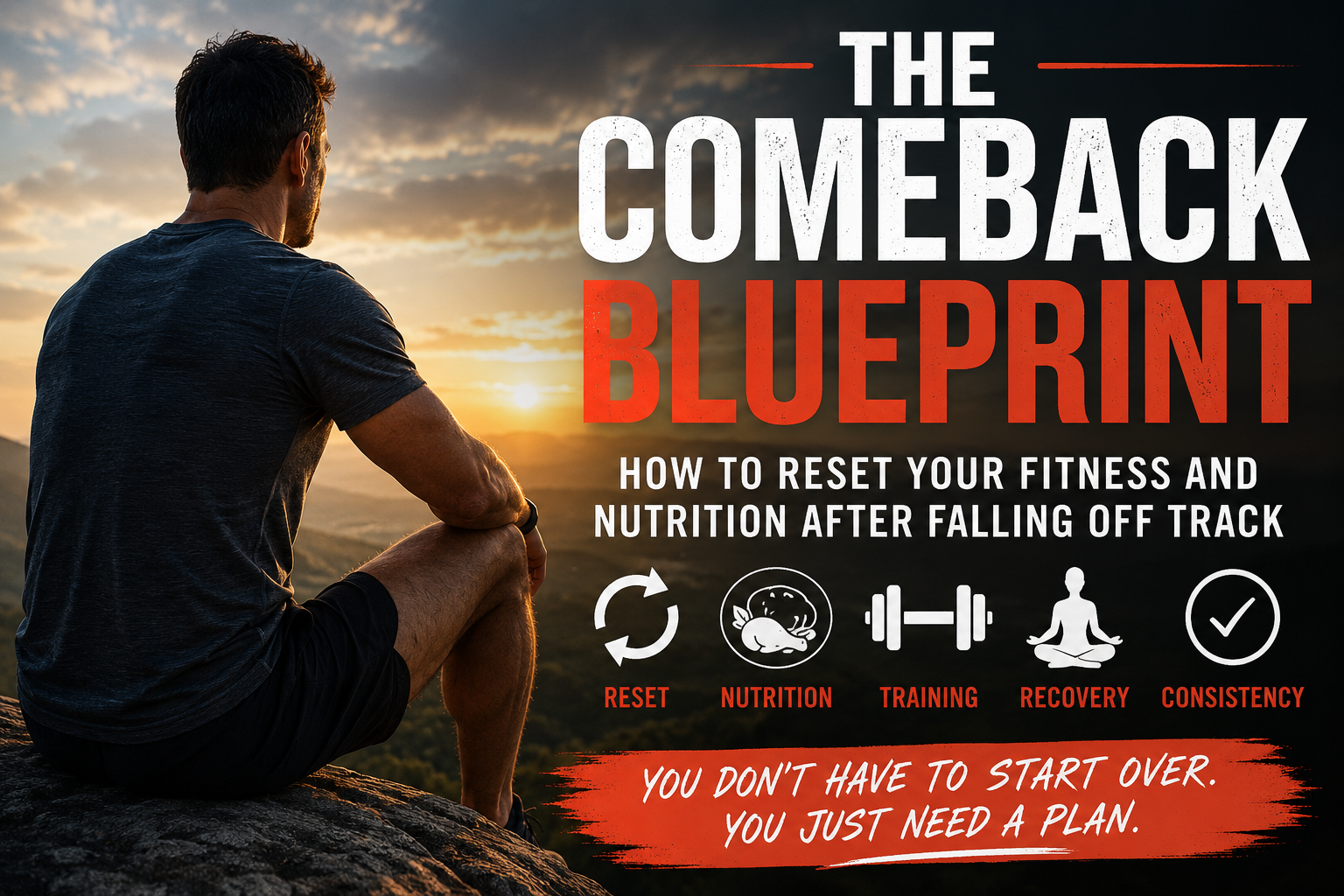
Falling off your health routine happens.
Work gets busy. Travel disrupts your schedule. An injury forces you to slow down. Stress builds up. Or sometimes you simply lose momentum.
Then a few missed workouts become a few weeks. Meals become less consistent. Sleep gets pushed aside. Before long, getting back on track can feel harder than it actually is.
But here's the good news: you don't need to start over.
You need a comeback strategy.
For adults 35 and older, the smartest approach isn't to punish yourself for the time you missed. It's to rebuild your routine in a way your body can actually sustain.
The goal isn't to make up for lost time.
The goal is to create momentum again.
1. Stop Trying to Make Up for Lost Time
One of the biggest mistakes people make after falling off their routine is trying to do everything at once.
They return to their old workout intensity, drastically cut calories, add extra cardio, and expect themselves to immediately return to their previous level of performance.
That's usually the wrong approach.
Start with consistency—not punishment.
If you haven't trained consistently for several weeks, your first workouts should feel like a re-entry, not a test of how much you can tolerate.
Instead of asking:
"How much did I lose?"
Ask:
"What can I consistently do this week?"
That shift matters.
Replace outcome goals with execution goals
You may eventually want to lose 10 pounds, gain muscle, improve your conditioning, or lower your waist measurement.
But those aren't today's actions.
Your immediate goals should be things you can actually execute:
Complete 3 workouts this week. Hit your protein target. Drink enough water. Get consistent sleep. Take a daily walk. Complete your mobility work.
Those small wins rebuild confidence—and confidence makes consistency easier.
And don't underestimate muscle memory
If you've trained consistently in the past, you aren't necessarily starting from zero.
Previous training adaptations can help you regain strength and muscle more quickly once you resume training consistently.
Your comeback may be faster than your original journey.
2. Rebuild Your Nutrition Before You Try to Perfect It
You don't need a cleanse.
You don't need to eliminate every carbohydrate.
And you don't need to survive on 1,200 calories because you missed a few weeks.
Your first objective is simpler:
Get your eating routine back under control.
Think of this as establishing your nutritional baseline again.
Start with the basics
1. Hydration
Get back into the habit of drinking water consistently throughout the day.
Rather than obsessing over one universal number, use your body size, activity level, climate, and sweat losses to determine how much you need.
2. Protein
Protein should be one of your first nutritional priorities when returning to training.
A practical target for many active adults is approximately 0.7–1.0 grams of protein per pound of body weight per day, adjusted for individual needs.
Rather than trying to consume it all at once, distribute protein across your meals.
3. Whole foods
Build most meals around recognizable foods:
Meat, poultry, fish, eggs or other protein sources Vegetables and fruit Potatoes, rice, oats, or other carbohydrate sources that work for you Nuts, seeds, olive oil and other sources of dietary fat
You don't need a perfect diet.
You need a repeatable one.
Don't overhaul everything on Day 1
Trying to change your workouts, diet, sleep, supplements, hydration and entire schedule simultaneously can create unnecessary friction.
Pick your highest-impact behaviors first.
Then build from there.
3. Use a Progressive Return to Training
Your first week back shouldn't be your hardest week.
It should be your foundation week.
Week 1 — Re-Activation Start with full-body training at a moderate effort. Focus on restoring movement, technique, range of motion, and consistency.
Week 2 — Build Gradually increase either the resistance, number of sets, or total training volume. Don't increase everything at once.
Week 3 and Beyond — Progress Once your body is responding well, begin moving back toward your normal training schedule and progressively increase the challenge.
You don't need to hit a specific percentage of your previous maximum just because a chart says you should.
Instead, use your current performance to determine where you begin.
Leave Something in the Tank
Your first sessions back should generally feel controlled.
Focus on:
Good technique Full, comfortable range of motion Controlled repetitions Adequate recovery between sessions Gradually increasing training demands
If your body responds well, increase the challenge.
If recovery is poor, adjust.
That's not weakness.
That's intelligent training.
Don't forget conditioning and mobility
Strength training doesn't have to be the only thing you rebuild.
Walking, moderate aerobic work and mobility can help you establish a more complete routine without making every session exhausting.
The goal is to become active again, not simply to become sore again.
- Rebuild Your Recovery Routine
This is where many comeback attempts fail.
People focus heavily on workouts and nutrition while treating recovery as optional.
It isn't.
Your training provides the stimulus.
Recovery is where you adapt to that stimulus.
Start rebuilding the fundamentals:
Sleep
Work toward a consistent sleep and wake schedule and give yourself enough time in bed.
Mobility
A few minutes of targeted mobility can be easier to maintain than an occasional 45-minute session.
Stress management
You don't need a complicated protocol.
Walking, breathing exercises, downtime, hobbies and simply creating space away from work can all contribute to a better recovery routine.
Rest days
A rest day isn't a missed workout.
It's part of the program.
5. Turn Your Comeback Into a Daily System
Here's the problem with relying on motivation:
Motivation changes.
Your system shouldn't.
When you're rebuilding your routine, having one place to see what you've done—and what still needs attention—can remove a lot of the mental work.
This is where Phoenix Fitness Pro fits naturally into the comeback process.
Instead of thinking about fitness as one isolated workout, you can treat your health as a collection of daily behaviors:
Nutrition → Hydration → Movement → Training → Mobility → Recovery → Sleep
The goal isn't to create another app you have to constantly manage.
The goal is to make your routine easier to see and follow.
Use your daily health data to make better decisions
Phoenix Fitness Pro can help you keep track of the behaviors that make up your routine, so you're not relying entirely on memory.
You can use it to:
Monitor your daily nutrition Keep protein intake on track Track hydration Record workouts and activity Follow mobility and recovery habits Monitor sleep See how consistently you're completing your routine
That creates something more valuable than another workout plan:
awareness of how your daily choices are adding up.
6. Your First 7 Days Back
Don't try to fix your entire life this week.
Just win the next seven days.
Your comeback checklist:
Day 1
Rehydrate Eat protein-centered meals Take a walk Go to bed at a reasonable time
Day 2
Complete a light or moderate workout Hit your protein target Do a short mobility session
Day 3
Recover Walk Focus on nutrition and hydration
Day 4
Train again Record your performance Avoid trying to beat your old numbers
Day 5
Mobility Walking or moderate cardio Prioritize sleep
Day 6
Third training session Evaluate how your body is responding
Day 7
Recover Review the week Identify what worked Plan the next week
The objective isn't a perfect seven days.
It's seven days of forward movement.
You Don't Have to Start Over
Falling off your routine doesn't erase the work you've already done.
You don't need to punish yourself for missing workouts.
You don't need an extreme diet.
And you don't need to wait for Monday.
You need a starting point.
Start with one workout.
One good meal.
One walk.
One night of better sleep.
Then do it again tomorrow.
That's how a comeback begins.
And eventually, those individual actions become something bigger:
a daily health routine you can actually maintain.
👉 Ready to get back on track? Start rebuilding your routine with Phoenix Fitness Pro.
You don't need to start over. You need a system for getting back on track.
Getting back on track isn't about perfection; it’s about execution. Focus on building momentum through small, consistent wins today.
👉 Ready to rebuild your routine? Open PhoenixFitnessPro.com to log your next meal and start your personalized Re-Activation Protocol.
Scientific References
- What Makes a Habit? Investigating Potential Determinants of Habits. Health psychology review, 2026.
- Effective techniques in healthy eating and physical activity interventions: a meta-regression. Health psychology, 2009.
Editorial & Scientific Integrity Disclaimer: This article is for informational and educational purposes only and does not constitute medical advice. Always consult a qualified healthcare professional before starting any supplement regimen or dietary change. All physiological and nutritional claims are referenced against primary clinical research (PubMed/NIH) throughout the text. Some links on this page may be affiliate links.
Written by Phoenix Wellness Team
The Phoenix Fitness Pro team researches every article against current evidence and real member experience so you get practical guidance, not hype.
Learn more about Phoenix Fitness Pro