
Dead Hangs: Benefits, Proper Form, and How Long to Hang
Written by John Solomou | Founder, Phoenix Wellness Team
Researched & Fact-CheckedPeer-Reviewed Clinical Literature (PubMed / NIH / ISSN)
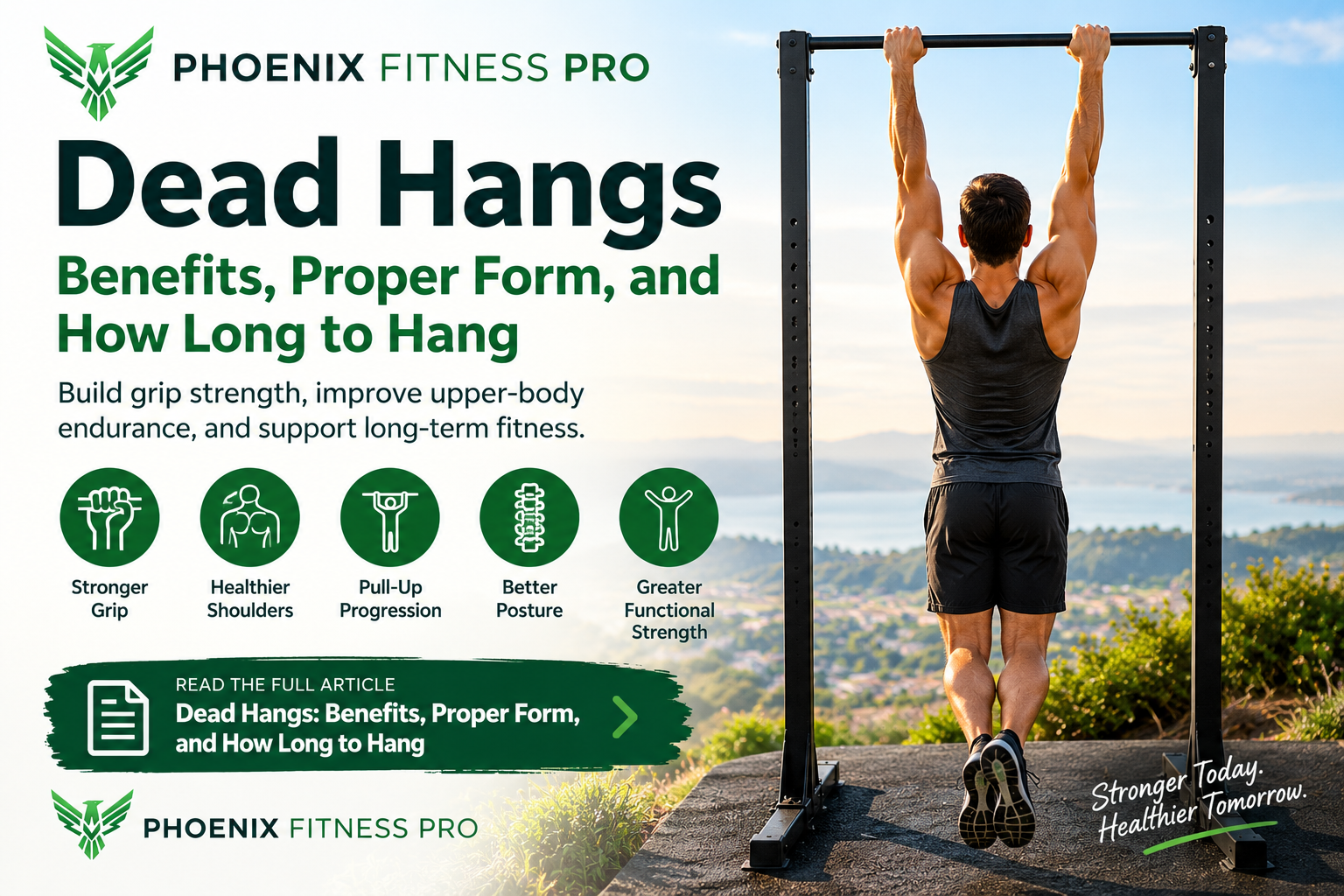
Dead Hangs: Benefits, How to Do Them, and How Long to Hang
A dead hang is a simple exercise in which you grip a bar overhead and let your body hang with your feet off the ground. It trains your grip and forearm endurance, challenges your shoulders to support your body weight, and provides a straightforward way to practice hanging strength without performing a pull-up.
For adults over 35, dead hangs can be a useful addition to a strength routine. However, they are not a cure for shoulder pain, and research does not establish that hanging from a bar automatically improves shoulder mobility or decompresses the spine.
Your starting point matters. If you cannot comfortably support your body weight, you can build up with your feet on the floor or a stable platform. You do not need to hold a hang for a minute to get started.
What Are the Benefits of Dead Hangs?
Dead hangs train several physical qualities at once. The most direct benefit is grip endurance, although the exercise also challenges your forearms, shoulder muscles, and ability to control your body while suspended.
1. They Train Grip Strength and Endurance
Your hands and forearms must maintain a firm grip while your body weight pulls downward. The longer you hold the bar, the longer those muscles must sustain tension.
This makes dead hangs useful for people who want to improve their ability to hold onto equipment, carry objects, or progress toward exercises such as pull-ups.
Grip strength also has a broader relationship with health. A 2022 systematic review and dose-response meta-analysis examined 48 studies involving more than 3.1 million adults aged 35 to 85. Higher measured handgrip strength was associated with lower mortality risk, although the relationship varied by cause of death. These observational findings do not prove that stronger grip causes longer life, and they do not show that dead hangs themselves prevent disease. They do support grip strength as a useful measure of physical function. ( PubMed research )
Dead hangs are one way to train your grip, but they are not the only option. Loaded carries, rows, and other resistance exercises also challenge your hands and forearms.
2. They Challenge Your Shoulders
When you hang from a bar, your arms remain overhead while your shoulders support your body weight. Your shoulder muscles and surrounding structures must manage that position.
A relaxed dead hang allows your shoulders to move into a more elevated position. An active hang adds muscular control by asking you to engage the muscles around your shoulder blades.
These positions are not interchangeable. A passive hang places more emphasis on tolerating the hanging position, while an active hang requires more deliberate muscular effort.
Some people find hanging comfortable and useful as part of their upper-body training. Others experience pinching, instability, or pain. There is not enough direct evidence to claim that dead hangs improve shoulder mobility for everyone.
If you have a history of shoulder dislocation, a recent shoulder injury, significant joint pain, or a condition that limits overhead movement, seek appropriate professional guidance before attempting full body-weight hangs.
3. They Can Help Prepare You for Pull-Ups
A pull-up requires you to support your body weight, maintain your grip, and pull yourself upward. A dead hang lets you practice the grip and starting position without needing to complete the pulling movement.
That makes it a useful entry point for people working toward their first pull-up.
Dead hangs alone will not develop all the strength needed for a pull-up. You also need to train the muscles that pull your body upward. Depending on your current ability, that might include assisted pull-ups, resistance-band pull-ups, lat pulldowns, and rows.
Research on dead-hang training in sport climbers has found improvements in grip endurance after structured training programs. However, the study involved 26 advanced climbers using specialized fingerboard protocols. Its results cannot be directly applied to beginners performing ordinary two-handed hangs from a pull-up bar. ( PubMed research )
4. They Let You Practice Supporting Your Body Weight
Hanging is a different challenge from lifting a weight in your hands. Your grip must remain secure while your shoulders and upper body support your suspended body.
That makes dead hangs a useful body-weight exercise, particularly when you want to build toward more demanding movements.
However, a dead hang is not a complete upper-body workout. It provides little of the pulling movement required to build strength through a full range of motion. Combine it with exercises such as rows, assisted pull-ups, and other resistance training for a more balanced routine.
5. They May Help You Explore Comfortable Overhead Positions
Some people have limited tolerance for keeping their arms overhead. A supported or modified hang can provide a way to practice that position gradually, provided it feels comfortable and is appropriate for their condition.
But hanging should not be treated as a guaranteed fix for stiff shoulders. Overhead mobility depends on several factors, including joint structure, muscle function, movement habits, and previous injuries.
If you want to improve shoulder mobility, use a broader approach that may include controlled shoulder movements, appropriate strength exercises, and mobility work tailored to your needs.
Do Dead Hangs Decompress Your Spine?
You may have seen claims that dead hangs decompress the spine, lengthen the body, or fix back pain.
These claims go beyond what the evidence establishes.
Hanging changes the forces acting on your body, and some people may find the position temporarily comfortable. That does not prove it produces lasting spinal decompression, corrects posture, increases height, or treats back problems.
If hanging causes back pain, numbness, tingling, or symptoms that travel down an arm or leg, stop. Do not use a dead hang as a substitute for an assessment of persistent symptoms.
How to Do a Dead Hang Correctly
The safest starting point is a secure bar that can support your body weight and a position you can enter and leave under control.
Step 1: Check the Bar
Use a stable pull-up bar installed according to its manufacturer's instructions. Check the equipment before each session, especially if you use a removable doorway bar.
Make sure the surrounding area is clear and that you can get down without jumping or dropping from the bar.
Step 2: Grip the Bar
Hold the bar with both hands around shoulder-width apart or slightly wider, depending on your comfort and the bar's design.
Wrap your thumbs around the bar when possible. Avoid relying on a loose fingertip grip.
Step 3: Lift Your Feet
Step onto a stable platform or use a controlled step-up to reach the bar. Once your grip is secure, lift your feet so your body is supported by your hands.
Keep your body still. You do not need to swing or force your shoulders into a position that feels uncomfortable.
Step 4: Choose a Comfortable Shoulder Position
For a passive hang, allow your shoulders to rise naturally as your arms extend overhead. Do not force the position if you feel pinching, sharp pain, or instability.
For an active hang, gently engage the muscles around your shoulder blades and move into a more controlled position without bending your elbows. The movement should be small and deliberate.
Start with the variation you can perform comfortably. You do not need to begin with a fully relaxed hang if that position is difficult for you.
Step 5: Come Down Under Control
Place your feet back on the platform or step down carefully. Avoid dropping from the bar, particularly when your grip is tired.
How Long Should You Dead Hang?
There is no single ideal dead-hang duration for everyone. Your grip strength, body weight, shoulder tolerance, training experience, and equipment all influence how long you can hang safely.
If you are new to the exercise, start with short holds rather than testing your maximum time.
| Experience level | Practical starting point | Main goal |
|---|---|---|
| Beginner | 5–10 seconds | Learn the position and build tolerance |
| Building capacity | 10–20 seconds | Develop grip endurance with control |
| More experienced | 20–30 seconds or longer if comfortable | Build endurance without sacrificing form |
These are suggested starting ranges, not scientifically established standards or performance requirements. Use a shorter hold if you cannot maintain a secure grip or comfortable shoulder position.
For example, if you can hang comfortably for 8 seconds, you might perform 3 holds of 5 seconds with enough rest between attempts. Once those holds feel controlled, gradually add a few seconds.
Do not chase a personal record every session. Stop before your grip fails.
A Simple Dead-Hang Progression for Beginners
You can adapt dead hangs to your current ability rather than forcing yourself to support your entire body weight from day one.
- Feet-supported hang: Keep your feet on the floor or a stable platform and use your hands to support only part of your weight.
- Short full hang: If you can safely support your weight, try a 5-second hold.
- Repeat short holds: Perform 2–4 comfortable holds, resting between attempts.
- Increase gradually: Add a few seconds when your current holds feel secure and controlled.
- Introduce active hangs: Once comfortable with the basic position, practice gentle shoulder-blade engagement without bending your elbows.
You can perform this progression two or three times per week as part of a broader training routine, provided you recover well between sessions. This is a practical suggestion, not a proven optimal schedule.
Avoid training to grip failure, especially when you are learning. A tired grip can fail suddenly.
What Equipment Do You Need?
You need a stable overhead bar that can safely support your body weight. You do not need expensive equipment, a gym membership, or specialized accessories to begin.
A doorway pull-up bar can be convenient for home training, but compatibility and installation matter. Door frames vary, and an incorrectly fitted bar can slip or damage the frame.
Home training option: Browse a Free standing pull-up bar on Amazon and check the manufacturer's installation requirements, weight rating, and compatibility with your doorway before purchasing.
You can also explore Phoenix Fitness Pro's recommended exercise equipment for other home-training options.
Amazon affiliate disclosure: As an Amazon Associate, Phoenix Fitness Pro may earn from qualifying purchases.
Common Dead-Hang Mistakes
Hanging for Too Long
Longer is not automatically better. If your grip starts slipping or your shoulders become uncomfortable, end the set. Build capacity over time instead of forcing a maximum hold.
Ignoring Shoulder Pain
A stretch or muscular effort is different from sharp pain, pinching, or a feeling that the joint may give way. Stop if the position causes these symptoms.
Swinging or Kipping
Swinging adds movement that is not necessary for a basic dead hang. Keep the exercise controlled, especially while learning.
Treating Dead Hangs as a Complete Workout
Dead hangs develop grip endurance and hanging tolerance, but they do not replace a balanced strength program. Include exercises that train pushing, pulling, legs, and the rest of your body.
Using an Unstable Bar
A slipping bar can cause a fall. Check installation and equipment condition, and never assume that a doorway bar fits simply because it can be wedged into place.
Questions People Ask
Are dead hangs good for everyone over 40?
Age alone does not determine whether dead hangs are appropriate. Many adults over 40 can use them as part of a strength routine, but shoulder health, grip capacity, previous injuries, and the ability to support body weight all matter. Begin with a supported variation if needed.
Should I do passive or active dead hangs?
A passive hang allows your shoulders to rise naturally while your arms remain extended. An active hang involves deliberate muscular engagement around the shoulder blades. Neither variation is best for every person, so choose based on your goal, comfort, and ability.
Can dead hangs improve grip strength?
They can train grip endurance because your hands must hold your body weight for a period of time. Grip strength and grip endurance are related but different qualities, and dead hangs do not measure or improve every aspect of grip performance equally.
How many times a week should I do dead hangs?
A practical starting point is two or three sessions per week, with short, controlled holds. Reduce the frequency or duration if your hands, elbows, or shoulders do not recover comfortably. There is no established dead-hang schedule that is optimal for everyone.
Can dead hangs fix shoulder pain?
There is not enough evidence to recommend dead hangs as a general treatment for shoulder pain. Hanging can aggravate some shoulder conditions. If you have persistent pain or a history of shoulder instability, get appropriate guidance before adding the exercise.
Are dead hangs better than pull-ups?
They train different things. Dead hangs emphasize grip endurance and supporting your body weight, while pull-ups also require pulling strength through a larger range of motion. If your goal is to perform pull-ups, dead hangs can be one part of your progression, not a complete replacement.
Scientific References
- Comparison of the Effects of Three Hangboard Strength and Endurance Training Programs on Grip Endurance in Sport Climbers. Journal of Human Kinetics, 2019. PubMed
- Thresholds of handgrip strength for all-cause, cancer, and cardiovascular mortality: A systematic review with dose-response meta-analysis. Ageing Research Reviews, 2022. PubMed
- Handgrip strength and health outcomes: Umbrella review of systematic reviews with meta-analyses of observational studies. Journal of Sport and Health Science, 2021. PubMed
Medical Disclaimer: This article is for educational purposes only and is not individualized medical advice. Exercise suitability varies by health status, ability, and injury history. Stop if an exercise causes pain, dizziness, numbness, or unusual symptoms, and consult a qualified healthcare professional when appropriate.
Editorial & Scientific Integrity Disclaimer: This article is for informational and educational purposes only and does not constitute medical advice. Always consult a qualified healthcare professional before starting any supplement regimen or dietary change. All physiological and nutritional claims are referenced against primary clinical research (PubMed/NIH) throughout the text. Some links on this page may be affiliate links.
Written by Phoenix Wellness Team
The Phoenix Fitness Pro team researches every article against current evidence and real member experience so you get practical guidance, not hype.
Learn more about Phoenix Fitness Pro