
Creatine, Glutathione, and Methylation: What the Science Actually Shows
Written by John Solomou | Founder, Phoenix Wellness Team
Researched & Fact-CheckedPeer-Reviewed Clinical Literature (PubMed / NIH / ISSN)
Creatine, Glutathione, and Methylation: What the Science Actually Shows
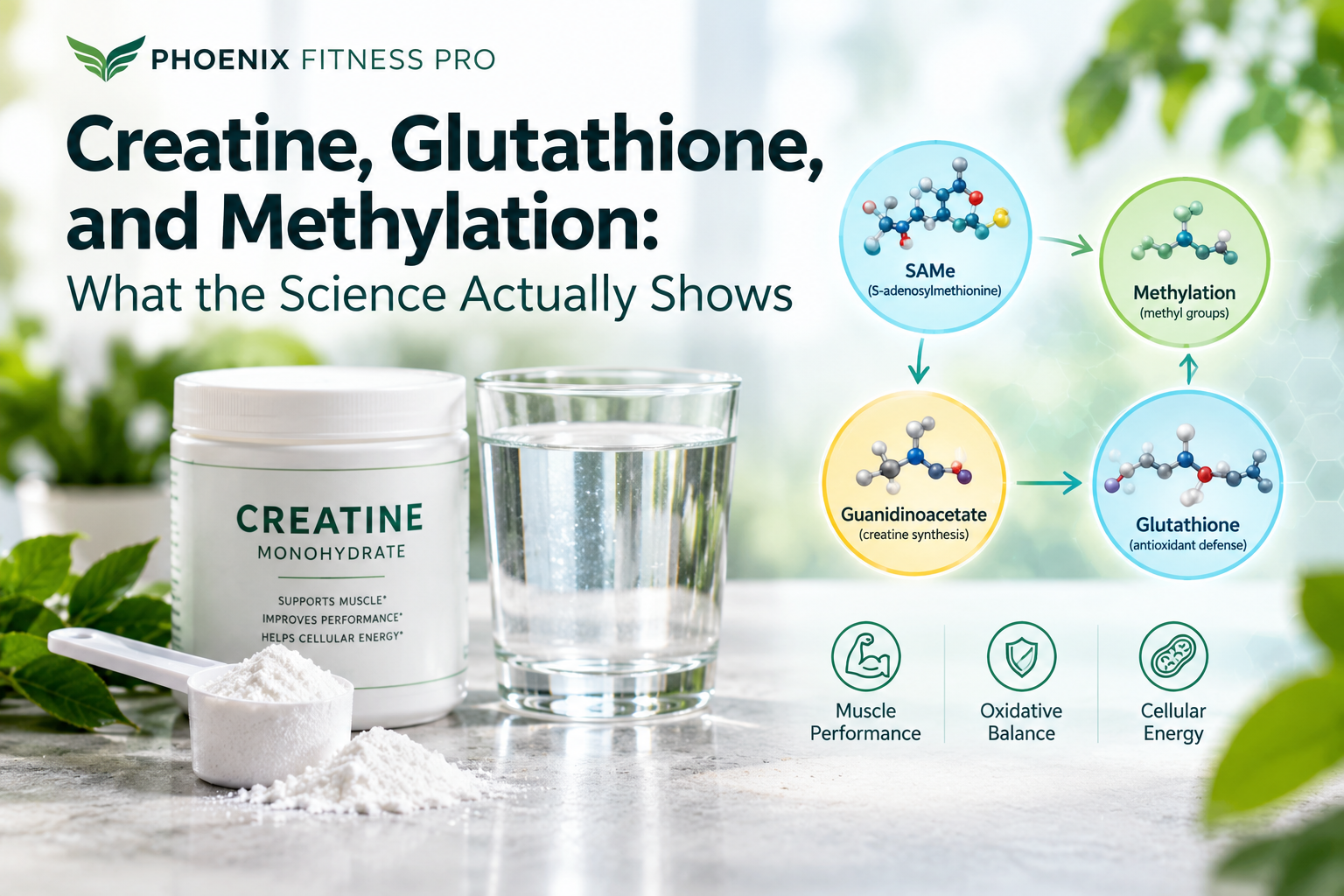
Creatine is best known for helping muscles produce energy during intense exercise. Your body also makes creatine naturally, and that process uses methyl groups involved in several important biochemical reactions. This connection has led researchers to investigate whether creatine supplements can reduce the body's methylation demands and influence glutathione, one of its major cellular antioxidants.
The evidence supports a specific conclusion: creatine supplementation can reduce the need for your body to manufacture creatine, a process that consumes methyl groups. However, human studies have not established that creatine reliably lowers homocysteine, improves methylation throughout the body, or increases glutathione levels on its own.
That does not diminish creatine's established value for strength, high-intensity exercise, and muscle development. It means we should separate its well-supported benefits from promising but less certain effects on cellular metabolism.
How Your Body Makes Creatine
Your body produces creatine primarily through a pathway involving the kidneys and liver, although other tissues contribute to creatine metabolism. You also obtain creatine from foods such as beef, pork, and fish.
Creatine helps cells regenerate adenosine triphosphate (ATP), the molecule they use to power cellular work. During short, intense efforts such as lifting weights, sprinting, or jumping, phosphocreatine helps replenish ATP quickly.
The body makes creatine in two main biochemical steps.
Step 1: Glycine and arginine form guanidinoacetate
An enzyme called arginine:glycine amidinotransferase, or AGAT, transfers a guanidino group from arginine to glycine. This reaction produces guanidinoacetate, commonly abbreviated as GAA, and ornithine.
Guanidinoacetate is an intermediate. Your body must convert it into creatine before it can contribute to the creatine pool.
Step 2: Guanidinoacetate receives a methyl group
An enzyme called guanidinoacetate N-methyltransferase, or GAMT, transfers a methyl group from S-adenosylmethionine (SAMe) to guanidinoacetate. This reaction produces creatine and S-adenosylhomocysteine (SAH).
That second step is the connection between creatine production and methylation.
SAMe supplies methyl groups for numerous reactions throughout the body, including processes involved in gene regulation, neurotransmitter metabolism, and the processing of other compounds. Creatine synthesis is one of its important uses.
A frequently cited estimate suggests that endogenous creatine production accounts for a substantial share of SAM-derived methyl-group use. The actual contribution varies with diet, creatine synthesis, tissue demand, and other factors. It should not be interpreted as a fixed percentage for every person.
What SAMe, SAH, and Homocysteine Tell Us About Methylation
Methylation is the transfer of a small chemical group containing one carbon atom and three hydrogen atoms. These reactions help regulate many biological processes.
Three compounds help explain the relationship between creatine and methylation.
SAMe: A major methyl-group donor
SAMe, also called S-adenosylmethionine, forms from the amino acid methionine and ATP. It donates methyl groups to many enzymes and biochemical reactions.
When SAMe donates a methyl group during creatine production, it becomes SAH.
SAH: A product of methyl-group transfer
SAH can be converted into homocysteine and adenosine. The relationship between these compounds matters because SAH can inhibit certain methyltransferase enzymes.
However, measuring SAMe or SAH alone does not reveal whether every methylation reaction in the body is functioning properly. Different tissues have different needs, and blood concentrations do not capture every intracellular process.
Homocysteine: A compound at a metabolic crossroads
Homocysteine forms during methionine metabolism. The body can recycle it back into methionine through pathways that depend on folate and vitamin B12, or route it toward cysteine production through a pathway that depends on vitamin B6.
Homocysteine is therefore connected to methyl-group metabolism, but it is not a complete measure of methylation health.
Its concentration can be influenced by nutritional deficiencies, kidney function, genetics, medications, age, and other health factors. An elevated result does not automatically prove a methylation disorder, and a normal result does not establish that every related pathway is functioning optimally.
Can Creatine Supplements Spare Methyl Groups?
Yes, creatine supplementation can reduce the need for endogenous creatine synthesis, which can reduce the methyl-group demand associated with that pathway. This is a biochemical explanation, not proof that supplementation improves every methylation process.
When you obtain additional creatine from a supplement, your body can reduce its own creatine production. Research has documented suppression of guanidinoacetate production during creatine supplementation.
The potential benefit is straightforward: if the body makes less guanidinoacetate and converts less of it into creatine, it may need fewer SAM-dependent methyl transfers for that particular task.
But three distinctions matter.
- Reduced demand is not the same as improved function. Sparing methyl groups does not automatically improve DNA regulation, neurotransmitter metabolism, or other methylation reactions.
- Biochemical changes do not guarantee clinical benefits. A shift in a metabolite does not establish better energy, mood, longevity, or disease prevention.
- The response varies. Diet, baseline creatine stores, supplementation, and individual metabolism influence the pathway.
The most accurate description is that creatine can reduce the body's need to synthesize creatine. Whether that translates into meaningful benefits for a person's overall methylation status remains uncertain.
What Human Trials Actually Show
Human research helps distinguish what happens in the body from what researchers hypothesize might happen.
A 12-week trial examined creatine, folic acid, and homocysteine
A randomized, placebo-controlled trial published in 2015 assigned Bangladeshi adults to placebo, 3 grams of creatine daily, 400 micrograms of folic acid daily, or both supplements for 12 weeks.
The study tested whether creatine would lower guanidinoacetate and homocysteine, raise SAM, and lower SAH.
Creatine supplementation lowered plasma guanidinoacetate, supporting the idea that supplemental creatine can suppress part of its own production pathway. However, the creatine-only group did not show a significant reduction in plasma total homocysteine compared with placebo. The findings did not establish a consistent, clinically meaningful improvement across the measured methylation markers.
The trial is important because it tested the proposed mechanism in humans rather than relying only on biochemical theory or animal experiments.
Reference: Low-Dose Creatine Supplementation Lowers Plasma Guanidinoacetate, but Not Plasma Homocysteine, in a Double-Blind, Randomized, Placebo-Controlled Trial. PubMed
An eight-week study examined resistance-trained men
A randomized study published in 2015 examined 60 young men assigned to a control group, creatine plus resistance training, or placebo plus resistance training. The creatine group used a loading phase followed by a maintenance dose over eight weeks.
Homocysteine declined from baseline in the creatine group. However, the researchers found no statistically significant difference among the groups in homocysteine levels.
This distinction matters. A statistically significant change within one group does not prove that the intervention outperformed the control group.
The study does not establish that creatine reliably lowers homocysteine or prevents cardiovascular disease.
Reference: Creatine Supplementation Alters Homocysteine Level in Resistance Trained Men. PubMed
What about SAMe, SAH, and guanidinoacetate?
The evidence is strongest for creatine's ability to reduce endogenous creatine synthesis and lower guanidinoacetate under studied conditions.
The evidence is less conclusive for consistent changes in circulating SAMe, SAH, and homocysteine that translate into measurable health benefits.
Researchers can measure these compounds to investigate metabolic pathways, but no single marker provides a complete assessment of methylation throughout the body. More human research is needed to determine whether specific groups benefit from changes in these pathways.
Creatine and Glutathione: Direct Evidence Versus Proposed Mechanisms
Glutathione is a small molecule found inside cells. It plays an important role in antioxidant defense, helps maintain cellular redox balance, and participates in the processing of certain compounds.
Because oxidative stress and cellular energy metabolism interact, researchers have investigated whether creatine supplementation can influence antioxidant systems.
There are plausible reasons to investigate the connection. Creatine supports rapid ATP regeneration, and changes in cellular energy availability may affect how cells respond to stress. Research has also examined possible effects of creatine on mitochondrial function and oxidative stress markers.
However, a plausible mechanism is not the same as a demonstrated increase in glutathione.
What does the human evidence show?
A 2021 review examined studies on creatine supplementation, physical exercise, and oxidative stress markers. The authors discussed possible antioxidant effects, including indirect effects related to cellular energy status and mitochondrial function. They also noted that the precise mechanism remains uncertain.
This review supports further investigation, but it does not establish that creatine consistently increases glutathione in humans.
Reference: Creatine Supplementation, Physical Exercise and Oxidative Stress Markers: A Review of the Mechanisms and Effectiveness. PubMed
What did a 2026 study find?
A 2026 secondary analysis of a randomized crossover trial examined 30 physically active older adults. Participants completed six-week phases involving either a combination of 3 grams of creatine plus 3 grams of beta-hydroxy-beta-methylbutyrate (HMB) daily or placebo while undertaking supervised exercise training.
Researchers examined oxidized glutathione and measures of glutathione redox balance.
The combination was associated with attenuation of a placebo-related increase in oxidized glutathione and a nominal preservation of the glutathione redox index. However, these effects did not remain statistically significant after adjustment for multiple comparisons.
This study has several limitations for anyone considering creatine specifically to increase glutathione:
- It tested creatine combined with HMB, not creatine alone.
- It included only 30 physically active older adults.
- It examined a limited intervention period.
- The glutathione-related findings did not remain statistically significant after the researchers adjusted for multiple comparisons.
The study is a useful research lead, not proof that creatine increases glutathione or treats low glutathione status.
Reference: Creatine plus β-Hydroxy-β-Methylbutyrate Supplementation Is Associated with Preserved Glutathione Redox-Balance and Redox-Function Associations in Older Adults: A Secondary Analysis of a Randomized Crossover Trial. PubMed
Can creatine directly increase glutathione production?
That has not been established reliably in humans.
Creatine and glutathione participate in different biochemical systems. Creatine supports cellular energy buffering. Glutathione helps maintain redox balance and supports antioxidant defenses.
They may interact indirectly through cellular metabolism, but creatine is not a building block of glutathione, and sparing methyl groups does not automatically increase glutathione synthesis.
If your goal is to support glutathione, focus first on adequate nutrition, sufficient protein, and the nutrients needed for normal amino acid and antioxidant metabolism. Do not assume that creatine alone will raise glutathione levels.
The Three Amino Acids Required for Glutathione Synthesis
Your cells manufacture glutathione from three amino acids: glutamate, cysteine, and glycine.
Each serves a specific role.
Glutamate
Glutamate forms part of glutathione's molecular structure. The body can obtain glutamate from dietary protein and produce it through normal amino acid metabolism.
Eating adequate protein helps supply the amino acids needed for many cellular processes, including glutathione synthesis.
Cysteine
Cysteine often acts as a limiting substrate for glutathione production. Your body can obtain it directly from food or produce it from methionine through the transsulfuration pathway, which involves vitamin B6-dependent reactions.
This creates a connection between methionine metabolism and glutathione availability. It does not mean that taking more methionine or cysteine will necessarily increase intracellular glutathione in a person who already has adequate nutrition.
Glycine
Glycine supplies the third amino acid required to make glutathione. It also participates in collagen production, creatine synthesis, and other biological processes.
Glycine is available in protein-rich foods, including meat, fish, and gelatin-containing foods. The amount required for normal glutathione production depends on overall physiology and nutritional status.
Should you take glycine to increase glutathione?
Not automatically.
Glycine is involved in both creatine and glutathione synthesis, but that does not mean everyone who takes creatine needs additional glycine. The body regulates amino acid metabolism through several pathways, and substrate availability is only one factor that affects glutathione production.
Supplementing glycine may be worth discussing in specific nutritional or clinical circumstances, but evidence does not establish that every healthy adult needs a glycine supplement alongside creatine.
Nutrients Involved in Methylation and Antioxidant Metabolism
Several nutrients help maintain the pathways involved in methyl-group transfer, homocysteine recycling, and glutathione production.
| Nutrient | Main role | Food sources |
|---|---|---|
| Folate (vitamin B9) | Supplies one-carbon units used in methionine recycling | Leafy greens, beans, lentils, fortified grains |
| Vitamin B12 | Supports the conversion of homocysteine back to methionine | Fish, meat, eggs, dairy, fortified foods |
| Vitamin B6 | Supports the transsulfuration pathway that helps produce cysteine | Poultry, fish, potatoes, bananas, chickpeas |
| Choline | Supports phospholipid production and can supply methyl groups through its metabolism | Eggs, meat, fish, soybeans |
| Betaine | Donates methyl groups for the conversion of homocysteine to methionine, particularly in the liver and kidneys | Beets, spinach, whole grains, shellfish |
| Glycine | Provides one of glutathione's three amino acids and contributes to creatine synthesis | Meat, fish, gelatin, protein-containing foods |
| Cysteine | Provides the sulfur-containing amino acid needed for glutathione synthesis | Poultry, meat, dairy, legumes, other protein foods |
| Glutamate | Provides another amino acid needed to form glutathione | Produced by the body and obtained through protein-containing foods |
These nutrients work within interconnected pathways. More is not always better, and supplementation does not automatically improve function if a person's intake is already adequate.
Vitamin B12 and folate deficiencies can contribute to elevated homocysteine. Choline and betaine participate in alternative methylation pathways. Vitamin B6 supports the pathway that converts homocysteine toward cysteine production.
The sensible approach is to identify dietary gaps and correct confirmed deficiencies with qualified guidance rather than taking large doses of several supplements in an attempt to manipulate laboratory markers.
Can Methylation Be Normal While Glutathione Is Low?
Yes. Methylation and glutathione metabolism overlap, but they are not the same process.
A person could have a normal homocysteine result and still have changes in glutathione concentration or redox status. Conversely, a person could have elevated homocysteine without having a proven glutathione deficiency.
Several factors influence glutathione status, including amino acid availability, the activity of enzymes involved in its synthesis and recycling, oxidative stress, illness, and tissue-specific demands.
Blood tests also have limitations. A plasma or whole-blood measurement does not necessarily reflect glutathione conditions inside every tissue.
For this reason, no single homocysteine, SAMe, SAH, or glutathione measurement should be interpreted as a complete score for cellular health. If you have abnormal laboratory results or symptoms that concern you, work with a qualified healthcare professional to determine which tests are appropriate and what they mean in your circumstances.
Does Creatine Help People With MTHFR Variants?
MTHFR is a gene that provides instructions for making an enzyme involved in folate metabolism. Common MTHFR variants can influence enzyme activity, but having a variant does not automatically mean that a person has a methylation disorder or needs a particular supplement.
Creatine has attracted interest because endogenous creatine production consumes SAM-derived methyl groups. Reducing the body's need to manufacture creatine is a plausible reason to investigate supplementation in people with altered one-carbon metabolism.
However, mechanistic reasoning is not enough to establish a treatment.
A case report has discussed creatine supplementation in the context of an MTHFR variant and elevated homocysteine, but a single case cannot demonstrate that creatine is an effective treatment for people with MTHFR variants. The clinical trial evidence also does not establish a consistent homocysteine-lowering effect from creatine alone.
Creatine should not be presented as a treatment for MTHFR variants, elevated homocysteine, or a methylation disorder. If you have persistently elevated homocysteine, your healthcare professional can assess potential causes, including folate or B12 status, kidney function, medications, and other relevant factors.
Creatine Dosage, Timing, and Supplement Selection
If your main goals are strength, muscle development, or exercise performance, creatine monohydrate is the best-studied form.
How much creatine do adults typically use?
A common maintenance dose for healthy adults is 3 to 5 grams of creatine monohydrate daily.
Some athletic protocols use a loading phase of approximately 20 grams daily, divided into smaller doses, for five to seven days before moving to a maintenance dose. Loading is optional. Taking a smaller daily dose will also increase muscle creatine stores over time, although saturation takes longer.
You do not need a loading phase specifically to support methylation or glutathione. There is no established creatine dose that reliably increases glutathione or improves methylation markers.
Does timing matter?
For most people, consistency matters more than exact timing. You can take creatine with a meal or at another convenient time.
There is no convincing evidence that taking creatine at a particular time of day improves methylation or glutathione production. You also do not need to combine it with glycine, betaine, or other methylation-related supplements unless there is a specific reason to do so.
What should you look for in a creatine supplement?
Choose a product that clearly identifies creatine monohydrate as the ingredient and provides a transparent serving size. Independent quality testing can provide additional reassurance about product identity and purity.
You do not need a complicated blend to obtain creatine's established exercise benefits. More expensive forms have not consistently demonstrated superior results over standard creatine monohydrate.
For readers comparing products, the Phoenix Fitness Pro Creatine Monohydrate Guide is a relevant starting point if that page is available on the site.
Safety Considerations and Kidney Blood Tests
Creatine monohydrate has been studied extensively in healthy adults, and research supports its safety when used appropriately. The strongest evidence concerns exercise performance, muscle creatine stores, and training adaptations.
That does not mean every person should start supplementation without considering their health.
Why can creatine raise serum creatinine?
Creatinine is a breakdown product of creatine metabolism. Because supplementation can increase the body's creatine pool, it can also affect serum creatinine levels.
A higher creatinine result does not automatically mean that creatine has damaged the kidneys. However, it should not automatically be dismissed either. Healthcare professionals interpret creatinine alongside other information, including the clinical context, trends over time, and other kidney-function measures.
Tell your healthcare professional if you take creatine before kidney-function testing. Depending on your circumstances, they may consider additional tests, such as cystatin C, or other measures to assess kidney function.
Who should seek medical advice before taking creatine?
Speak with a qualified healthcare professional before supplementing if you have kidney disease, a history of kidney problems, a relevant medical condition, are pregnant or breastfeeding, or take medication that may affect kidney function.
Follow individualized medical guidance if you have an existing condition or abnormal laboratory results. Do not use creatine as a replacement for prescribed treatment or as a way to manage elevated homocysteine without evaluating its cause.
For a broader review of creatine's safety and performance evidence, see the International Society of Sports Nutrition position stand. Full scientific review
Common Myths About Creatine, Glutathione, and Methylation
Myth 1: Creatine fixes methylation
Creatine can reduce the need for endogenous creatine synthesis, which uses SAM-derived methyl groups. That does not prove it improves methylation throughout the body or treats a methylation disorder.
Myth 2: Creatine always lowers homocysteine
Human trials have not consistently shown that creatine alone lowers homocysteine compared with placebo. Elevated homocysteine has multiple possible causes and requires context.
Myth 3: Creatine is a proven glutathione booster
The mechanisms are worth studying, but evidence that creatine alone reliably increases glutathione in humans remains insufficient. A recent study of creatine combined with HMB produced preliminary findings that did not remain significant after adjustment for multiple comparisons.
Myth 4: Everyone who takes creatine needs glycine
Glycine participates in both creatine and glutathione synthesis. That does not mean supplementation is necessary for everyone. Dietary adequacy, individual needs, and clinical circumstances matter.
Myth 5: Normal homocysteine means all methylation pathways are healthy
Homocysteine is one marker within a complex network of biochemical reactions. A normal result cannot confirm that every methylation or antioxidant pathway is functioning optimally.
Myth 6: A higher creatinine result proves kidney damage
Creatine supplementation can raise serum creatinine without necessarily reducing kidney function. The result needs appropriate clinical interpretation rather than an automatic conclusion in either direction.
Frequently Asked Questions
Does creatine increase glutathione?
It has not been established that creatine alone reliably increases glutathione in humans. Research suggests possible links between creatine, cellular energy, oxidative stress, and redox balance, but results are preliminary. A 2026 study of creatine combined with HMB in older adults reported some glutathione-related changes that did not remain significant after adjustment for multiple comparisons.
Does creatine reduce methylation demands?
Yes, it can reduce the methyl-group demand associated with endogenous creatine production. The body uses SAMe to convert guanidinoacetate into creatine, and supplemental creatine can suppress part of this production pathway. However, reduced methyl-group use does not prove that overall methylation improves or that the change produces a clinical benefit.
Can creatine lower homocysteine?
The results are mixed. A 12-week randomized trial found that 3 grams of creatine daily lowered guanidinoacetate but did not significantly lower plasma homocysteine compared with placebo. An eight-week study in resistance-trained men also found no significant difference in homocysteine between groups. Creatine is not an established treatment for elevated homocysteine.
Should you take creatine with glycine?
Not necessarily. Glycine is involved in both creatine and glutathione synthesis, but taking creatine does not automatically create a glycine deficiency. There is insufficient evidence that every healthy adult needs supplemental glycine alongside creatine. Consider your overall diet and seek professional advice if you have a specific nutritional or medical concern.
Does creatine help people with MTHFR variants?
There is not enough clinical evidence to recommend creatine as a treatment for MTHFR variants or associated metabolic concerns. Creatine's methyl-group use provides a plausible research mechanism, but a mechanism does not establish a clinical treatment. If you have elevated homocysteine or concerns about folate metabolism, a healthcare professional can help assess relevant laboratory results and nutritional factors.
What is the best creatine dose for general health?
A common maintenance dose is 3 to 5 grams of creatine monohydrate daily for healthy adults who choose to supplement. There is no established dose specifically for increasing glutathione or improving methylation. Loading is optional for exercise goals and is not required to obtain benefits over time. People with relevant medical conditions should discuss supplementation with a healthcare professional.
Can creatine affect kidney blood tests?
Yes. Creatine can raise serum creatinine, a breakdown product used in common kidney-function estimates. This does not necessarily indicate kidney injury, but results should be interpreted in context. Tell your healthcare professional about supplementation so they can assess the result appropriately and consider additional measures when needed.
Can you improve glutathione without taking a glutathione supplement?
Your body makes glutathione from glutamate, cysteine, and glycine. Eating enough protein and maintaining adequate intake of relevant nutrients supports normal metabolism. Overall health, illness, oxidative stress, and enzyme activity also influence glutathione status. No single food or supplement guarantees higher intracellular glutathione, and people with suspected deficiency or medical concerns should seek individualized assessment.
Scientific References
- Low-Dose Creatine Supplementation Lowers Plasma Guanidinoacetate, but Not Plasma Homocysteine, in a Double-Blind, Randomized, Placebo-Controlled Trial. American Journal of Clinical Nutrition, 2015. PubMed
- Creatine Supplementation Alters Homocysteine Level in Resistance Trained Men. Journal of Sports Medicine and Physical Fitness, 2015. PubMed
- Creatine Supplementation, Physical Exercise and Oxidative Stress Markers: A Review of the Mechanisms and Effectiveness. Nutrients, 2021. PubMed
- Creatine plus β-Hydroxy-β-Methylbutyrate Supplementation Is Associated with Preserved Glutathione Redox-Balance and Redox-Function Associations in Older Adults: A Secondary Analysis of a Randomized Crossover Trial. Biogerontology, 2026. PubMed
- International Society of Sports Nutrition Position Stand: Safety and Efficacy of Creatine Supplementation in Exercise, Sport, and Medicine. Journal of the International Society of Sports Nutrition, 2017. Full text in PubMed Central
- Creatine in Health and Disease. Substantial evidence describes creatine synthesis, transport, metabolism, and clinical relevance. Use the existing references above for the specific claims in this article; additional claims about glutathione synthesis should be supported by dedicated research before publication.
Medical Disclaimer
Phoenix Fitness Pro provides educational information about nutrition, exercise, and health. This article is not a diagnosis or a substitute for individualized medical advice, diagnosis, or treatment. Consult a qualified healthcare professional about supplement use, abnormal laboratory results, kidney conditions, or concerns about methylation and glutathione metabolism.
Author: John Solomou Organization: Phoenix Wellness Team Brand: Phoenix Fitness Pro
Editorial & Scientific Integrity Disclaimer: This article is for informational and educational purposes only and does not constitute medical advice. Always consult a qualified healthcare professional before starting any supplement regimen or dietary change. All physiological and nutritional claims are referenced against primary clinical research (PubMed/NIH) throughout the text. Some links on this page may be affiliate links.
Written by Phoenix Wellness Team
The Phoenix Fitness Pro team researches every article against current evidence and real member experience so you get practical guidance, not hype.
Learn more about Phoenix Fitness Pro