
Build an Affordable Home Gym Without Wasting Money
Written by John Solomou | Founder, Phoenix Wellness Team
Researched & Fact-CheckedPeer-Reviewed Clinical Literature (PubMed / NIH / ISSN)
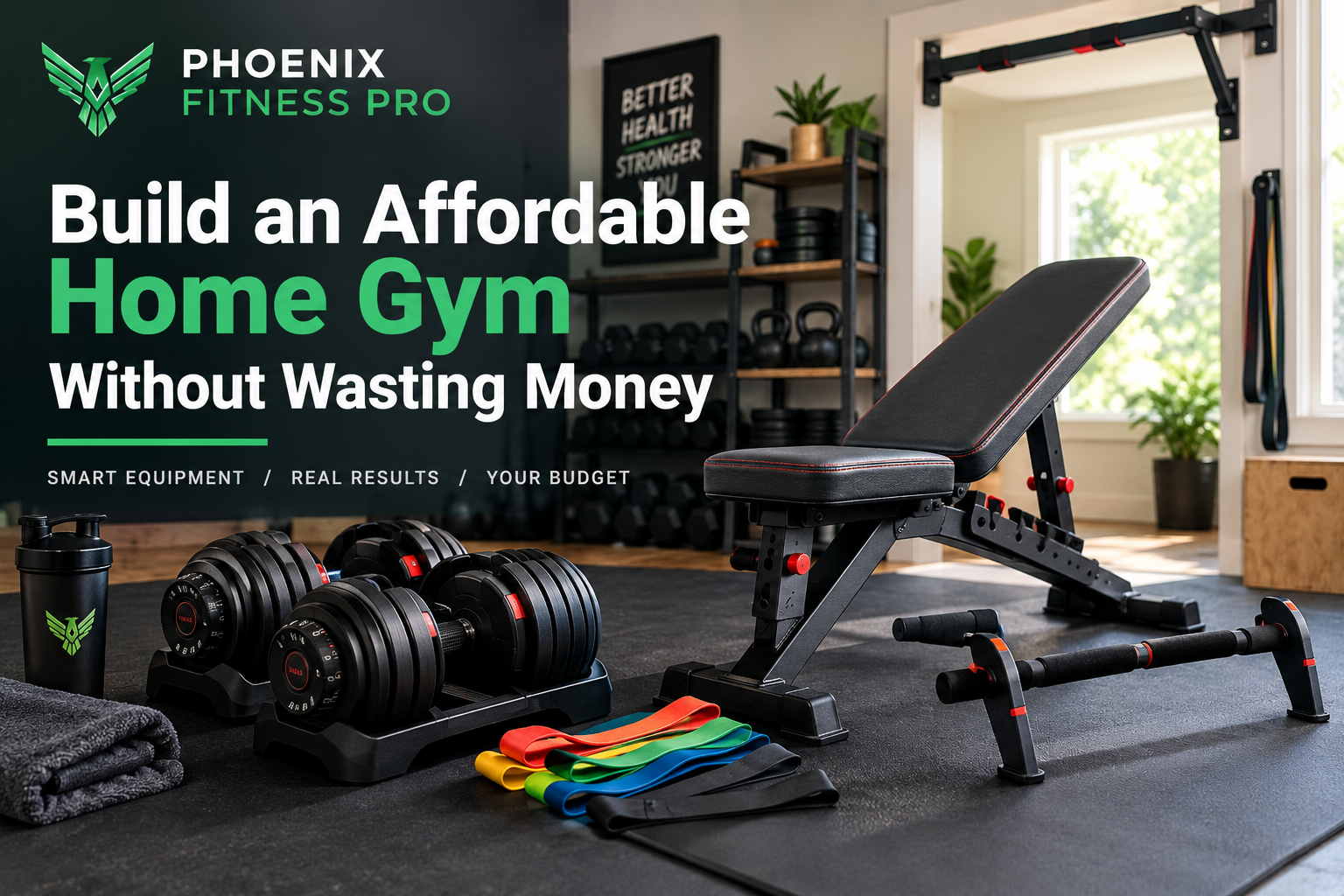
Build an Affordable Home Gym Without Wasting Money
You can build an effective home gym without spending thousands of dollars. A pair of adjustable dumbbells, resistance bands, a stable workout space, and a consistent training plan can cover most of your strength-training needs. You can add a bench or pull-up bar later as your workouts develop.
The biggest mistake is buying equipment before deciding how you will use it. Start with the exercises you want to perform, choose equipment that supports those movements, and spend more only when your training gives you a reason to.
For adults 35 and older, a home gym can make strength training easier to fit into a busy schedule. You avoid commuting to a gym, waiting for equipment, and paying a recurring membership fee. You also get to train at your own pace.
How Much Does an Affordable Home Gym Cost?
Your budget depends on what you already own, the type of training you prefer, and whether you buy new or used equipment. You do not need to purchase everything at once.
| Budget | What to prioritize | Best use |
|---|---|---|
| $25–$75 | Resistance bands and a floor mat you already own or can improvise without | Basic full-body workouts |
| $100–$250 | Bands plus adjustable dumbbells, depending on the deal | Progressive strength training |
| $250–$500 | Adjustable dumbbells and a suitable bench | More exercise variety and loading options |
| $500+ | Add a pull-up bar or other equipment based on your needs | A more complete home setup |
These are planning ranges, not guaranteed current prices. Equipment costs vary by brand, weight capacity, quality, and sales. Check current prices and product specifications before buying.
A practical starting point: If your budget is tight, buy one or two items that let you train your entire body. You can build a useful routine with resistance bands and bodyweight exercises, then add adjustable dumbbells when you are ready to increase the resistance.
The Four Pieces of Equipment Worth Considering
You do not need every type of fitness equipment. These four options cover a wide range of movements and can work together in a small home gym.
1. Adjustable Dumbbells: Your Main Strength Tool
Adjustable dumbbells let you change the resistance without filling a room with separate pairs of weights. Depending on their weight range, they can support exercises such as:
- Goblet squats
- Dumbbell rows
- Floor presses
- Overhead presses
- Romanian deadlifts
- Biceps curls
- Lunges and split squats
They are a strong first purchase if you want to build muscle or maintain strength at home. Choose a weight range that gives you room to progress. Very light dumbbells may work well initially but become limiting as your strength improves.
Before buying, check the maximum weight per dumbbell, how the adjustment mechanism works, the space required, and whether changing weights between exercises will interrupt your workouts.
See the adjustable dumbbells option here: View adjustable dumbbells.
2. Resistance Bands: Low-Cost Versatility
Resistance bands take up little space and can add resistance to many movements. You can use them for rows, presses, pull-aparts, lateral walks, assisted pull-ups, and warm-up exercises.
Bands can also help you train when you cannot use heavier weights. Research supports resistance-band training as one effective form of resistance exercise, although the resistance and progression options differ from those of free weights.
Choose bands that suit the exercises you plan to perform. A set with several resistance levels gives you more options than a single light band. Inspect bands for cracks, tears, or other damage, and secure them carefully before use.
See the resistance bands option here: View resistance bands.
3. An Adjustable Weight Bench: More Exercise Options
A bench can make dumbbell training more comfortable and expand the movements you can perform. It can support flat or incline presses, chest-supported rows, seated shoulder presses, and other exercises.
You do not need a bench on day one. Floor presses, standing rows, goblet squats, and Romanian deadlifts can already form the foundation of a useful routine.
If you buy a bench, check its stated weight capacity, stability, dimensions, adjustment positions, and whether it fits your training space. Follow the manufacturer's assembly and safety instructions.
See the adjustable bench option here: View an adjustable weight bench.
4. A Pull-Up Bar: Useful, but Not Essential
A pull-up bar gives you a way to train vertical pulling movements at home. Pull-ups and chin-ups can challenge the muscles of your back, arms, and upper body, but they may be too difficult for beginners without assistance.
You can train your back with dumbbell rows and resistance-band rows before adding pull-ups. That makes a bar a useful upgrade, not a requirement.
Check the installation method, doorway compatibility, maximum rated load, and manufacturer instructions before use. Do not assume a bar is safe for your doorway simply because it fits.
See the pull-up bar option here: View a pull-up bar.
You can also browse the Phoenix Fitness Pro equipment guide for other equipment categories to consider as your needs change.
What You Can Skip When Starting Out
A small home gym can work well without expensive machines, elaborate storage systems, or a room full of accessories.
You can usually postpone:
- A full dumbbell rack when adjustable dumbbells meet your needs
- Multiple single-purpose machines
- Specialty bars before you have established a training routine
- Expensive flooring if you already have a safe, stable surface suitable for your exercises
- Recovery gadgets that do not address a clear need
- Duplicate equipment that performs the same function
You also do not need to buy everything in one order. Use your initial setup for several weeks, identify which exercises you perform regularly, and decide what would genuinely improve your training.
How to Choose Equipment Without Wasting Money
A simple buying process can prevent you from spending money on equipment that sits unused.
Step 1: Choose Your Main Goal
Your goal affects which equipment should come first.
- Build muscle: Prioritize adjustable dumbbells or another form of resistance you can increase over time.
- Start exercising on a budget: Begin with resistance bands and bodyweight movements.
- Train your upper body: Dumbbells and bands cover many pushing and pulling movements. A pull-up bar can add vertical pulling.
- Train in a small space: Choose equipment that stores easily and can be set up quickly.
Step 2: Plan Your Workouts Before Shopping
Write down a few exercises for each major movement pattern. For example, you could plan a squat, a hip-hinge movement, a push, a pull, and a core exercise.
If the equipment you already own can cover those movements, you may not need to buy anything else yet.
Step 3: Check the Details, Not Just the Price
Before purchasing, review the product's dimensions, resistance or weight range, assembly requirements, storage needs, and safety instructions. A cheaper product is not a good value if it cannot support the exercises you intend to perform.
For used equipment, inspect it in person when possible. Look for damaged cables, cracked components, unstable frames, worn adjustment mechanisms, and missing parts.
Step 4: Leave Room to Progress
Your equipment should match your current ability while allowing you to increase the challenge. You can progress by using more resistance, performing more repetitions, improving your technique, or choosing a harder variation.
If you repeatedly reach the top of your planned repetition range and can still perform additional repetitions with good technique, it may be time to increase the resistance or make the movement more challenging.
A Simple Full-Body Home Workout
You can train your whole body with adjustable dumbbells and resistance bands. A bench and pull-up bar add options, but neither is essential for this routine.
Start with two sessions per week on nonconsecutive days. Choose a resistance that allows controlled repetitions without sacrificing technique. Rest as needed between sets.
| Exercise | Sets | Repetitions |
|---|---|---|
| --- | ---: | ---: |
| Goblet squat | 2–3 | 8–12 |
| Dumbbell floor press | 2–3 | 8–12 |
| One-arm dumbbell row | 2–3 | 8–12 per side |
| Dumbbell Romanian deadlift | 2–3 | 8–12 |
| Resistance-band pull-apart | 2 | 10–15 |
| Plank | 2 | 15–45 seconds |
These are starting ranges, not mandatory targets. Adjust the workout to your experience, mobility, available equipment, and recovery. Stop an exercise if you experience sharp pain, dizziness, chest discomfort, or unusual shortness of breath, and seek appropriate medical care for concerning symptoms.
How to Make the Workout Harder Over Time
Progressive resistance training helps improve strength and muscle size. A 2026 American College of Sports Medicine position stand reviewed 137 systematic reviews involving more than 30,000 participants and found that resistance training improved several measures of muscular fitness and physical function in healthy adults. The authors emphasized that multiple forms of resistance training can be effective. (PubMed)
Use a simple progression method:
- Choose a repetition range, such as 8–12.
- Start with a load you can control while maintaining good technique.
- Add repetitions as the exercise becomes easier.
- When you can complete the upper end of the range with good form, increase the resistance if possible.
- Record the weight, repetitions, and sets so you can see whether you are progressing.
You do not need to train to complete muscular failure on every set. Consistency, appropriate effort, and gradual progression matter more than making every workout exhausting.
How Much Space Do You Need?
A home gym does not need a dedicated room. You need enough clear space to perform your planned movements without hitting furniture, walls, or other people.
Before each session, check that:
- You can extend your arms and move the weights through the full range of motion.
- The floor is stable and not slippery.
- Your equipment can be stored safely between workouts.
- Children and pets cannot access weights or bands while you are training.
- Any wall-mounted or doorway equipment is installed and used according to its instructions.
If you live in an apartment, adjustable dumbbells and bands are often easier to store than large machines. Consider noise, floor protection, and the space required to set down weights safely.
Common Home Gym Buying Mistakes
Buying Too Much Before You Start
A large equipment collection will not make you consistent. Start with the basics, establish a routine, and add equipment only when you know what is missing.
Choosing Weights That Are Too Light
Light weights can be useful, especially for beginners and some exercises. But if your dumbbells no longer challenge you, you may need a greater resistance range or a harder exercise variation.
Ignoring Safety and Fit
Check weight ratings, adjustment mechanisms, doorway compatibility, and assembly requirements. Follow the manufacturer's instructions, especially for pull-up bars and benches that support your body weight.
Expecting Equipment to Do the Work for You
Equipment makes training possible, but it does not replace a sensible plan. A simple routine that you follow consistently is more useful than an expensive setup you rarely use.
Questions People Ask
What is the best home gym equipment for beginners?
Adjustable dumbbells and resistance bands are practical starting points because they support many exercises and take up relatively little space. If your budget is extremely limited, bands and bodyweight exercises can help you begin without a large upfront purchase.
Can I build muscle with a home gym?
Yes. Home workouts can support muscle growth when you train consistently and use enough resistance to challenge the target muscles. You also need to increase the challenge over time and support training with adequate food, protein, and recovery.
Is a weight bench necessary for a home gym?
No. A bench expands your options, but you can perform floor presses, rows, squats, hip hinges, and many other exercises without one. Buy a bench when it supports exercises you intend to perform regularly.
Are resistance bands enough for strength training?
They can provide effective resistance for many exercises and are useful for beginners, travel, and small spaces. Your ability to progress depends on the available resistance levels and the exercises you perform. You may eventually want dumbbells or other equipment for more loading options.
Do I need a pull-up bar to train my back?
No. Dumbbell rows and resistance-band rows train pulling movements without a pull-up bar. A bar is a useful addition if you want to practice pull-ups or chin-ups and can install it safely.
How often should I train at home?
Two full-body resistance-training sessions per week are a reasonable starting point for many healthy adults. Adjust frequency and workload based on your experience, goals, schedule, and recovery. If you have a health condition or have been advised to limit exercise, ask a qualified healthcare professional how to approach training safely.
Should I buy new or used gym equipment?
Either can work. Used equipment may reduce the cost, but inspect it for wear, damage, stability, missing parts, and compatibility with your space. For adjustable weights, benches, and pull-up bars, pay particular attention to the components that lock, support, or secure the load.
Scientific References
- American College of Sports Medicine Position Stand. Resistance Training Prescription for Muscle Function, Hypertrophy, and Physical Performance in Healthy Adults: An Overview of Reviews. Medicine & Science in Sports & Exercise, 2026. PubMed
Editorial & Scientific Integrity Disclaimer: This article is for informational and educational purposes only and does not constitute medical advice. Always consult a qualified healthcare professional before starting any supplement regimen or dietary change. All physiological and nutritional claims are referenced against primary clinical research (PubMed/NIH) throughout the text. Some links on this page may be affiliate links.
Written by Phoenix Wellness Team
The Phoenix Fitness Pro team researches every article against current evidence and real member experience so you get practical guidance, not hype.
Learn more about Phoenix Fitness Pro