
20-Minute Full-Body Workout for Adults Over 35: A Practical 2027 Guide
Written by John Solomou | Founder, Phoenix Wellness Team
Researched & Fact-CheckedPeer-Reviewed Clinical Literature (PubMed / NIH / ISSN)
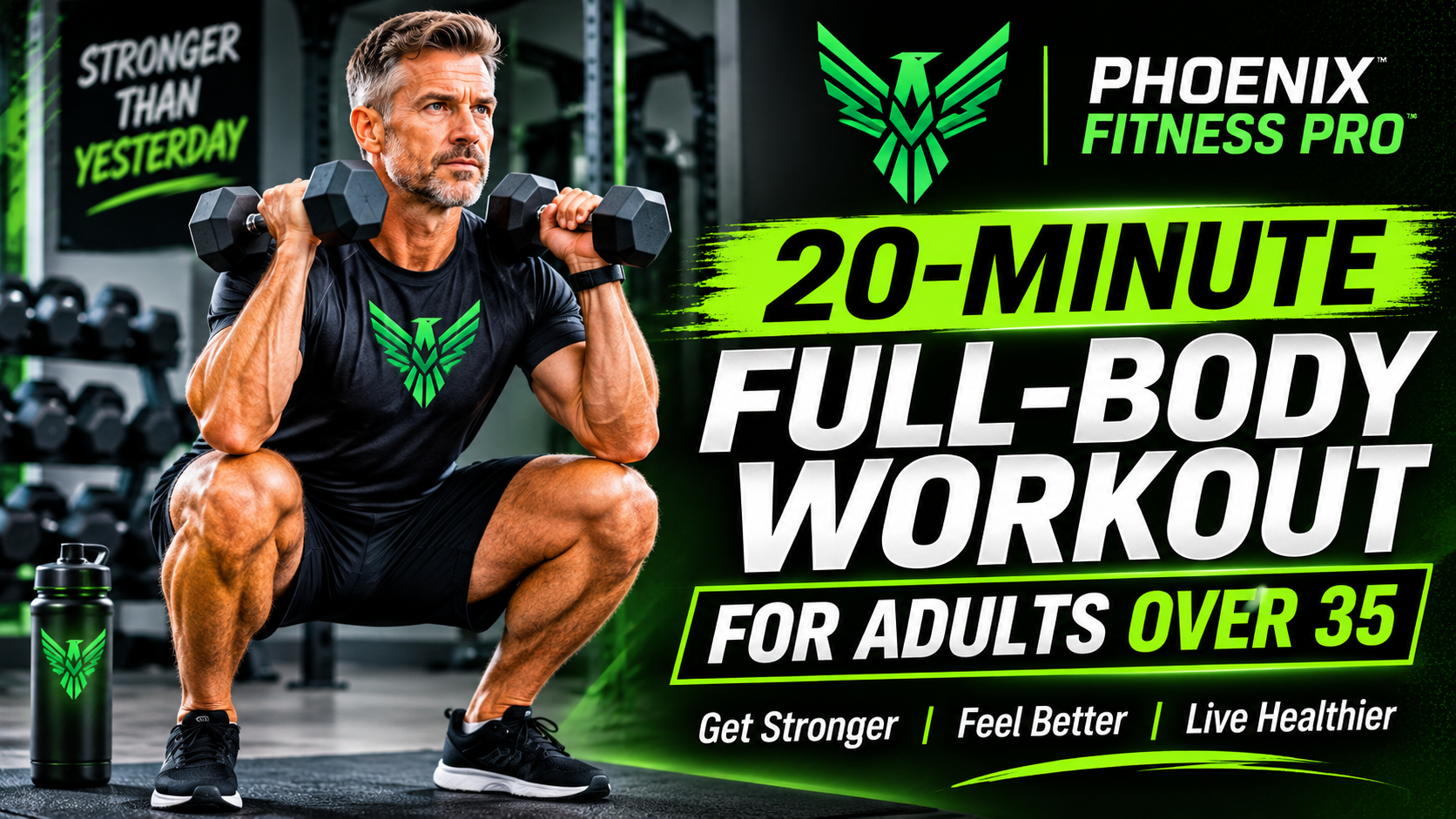
20-Minute Full-Body Workout for Adults Over 35: A Practical 2027 Guide
A busy schedule doesn't have to keep you from getting stronger. A well-planned 20-minute full-body workout can help you train your major muscle groups, maintain muscle, and build a consistent exercise routine without spending an hour in the gym.
As we head into 2027, the fundamentals haven't changed: consistent resistance training, gradual progression, adequate recovery, and a routine you can actually maintain. The challenge is finding a practical way to put those fundamentals into your everyday life.
This workout gives adults over 35 a simple starting point. It uses five exercises, requires minimal equipment, and can be adapted to your fitness level. You can do it at home with dumbbells, resistance bands, or bodyweight variations.
What Makes a Good 20-Minute Workout in 2027?
A short workout should not be a random collection of exercises. It should cover the major movement patterns, challenge your muscles appropriately, and give you a way to progress.
The American College of Sports Medicine's 2026 resistance-training position stand reviewed 137 systematic reviews involving more than 30,000 participants. Its findings reinforce the value of resistance training for improving strength, muscle size, power, endurance, and physical function.
The review also found that different forms of resistance training can be effective, including home-based training, resistance bands, and circuit-style approaches.
That matters if you have limited time or don't have access to a traditional gym. You don't need an elaborate setup to start building a consistent strength-training habit.
However, the research does not establish 20 minutes as a magic workout duration. The goal is to make the time you have productive and build on it as your strength and experience improve.
The 20-Minute Full-Body Workout
This routine includes five movements that work your legs, chest, back, hips, and core.
| Exercise | Main muscles | Repetitions |
|---|---|---|
| Squat or chair squat | Quadriceps and glutes | 8–12 |
| Incline push-up | Chest, shoulders, and triceps | 8–12 |
| Dumbbell or band row | Back and biceps | 8–12 per side |
| Hip hinge or glute bridge | Glutes and hamstrings | 10–12 |
| Dead bug | Core and trunk stability | 8–10 per side |
Complete two rounds if your fitness level allows. Beginners can start with one round and build up gradually.
1. Squat or Chair Squat
Squats train the quadriceps and glutes while challenging your ability to control your body through a lower-body movement.
- Stand with your feet approximately shoulder-width apart.
- Push your hips back and bend your knees.
- Lower yourself as far as you can comfortably control.
- Push through your feet to return to standing.
If you're new to exercise, use a chair as a target. Lower yourself toward it, pause briefly, and stand back up.
2. Incline Push-Up
Incline push-ups train your chest, shoulders, and triceps. Raising your hands on a stable surface reduces the amount of body weight you have to push.
- Place your hands on a stable bench, countertop, or other secure elevated surface.
- Keep your body in a straight line.
- Lower your chest toward the surface.
- Push back to the starting position.
Choose an incline that allows you to complete your repetitions with controlled form. As you get stronger, use a lower surface or progress toward floor push-ups.
3. Dumbbell or Resistance Band Row
Rows strengthen the muscles of your upper back and help balance your pushing exercises.
- Hold a dumbbell in each hand or use a securely anchored resistance band.
- Hinge forward at your hips while keeping your back controlled.
- Pull your elbows toward your sides.
- Lower the weight or release the band under control.
If you only have one dumbbell, perform the exercise one side at a time.
4. Hip Hinge or Glute Bridge
This movement trains your posterior chain, particularly your glutes and hamstrings.
For a hip hinge:
- Stand with your feet about hip-width apart.
- Keep a slight bend in your knees.
- Push your hips backward while keeping your spine in a comfortable, neutral position.
- Drive your hips forward to stand upright.
For a glute bridge:
- Lie on your back with your knees bent and feet flat.
- Tighten your glutes.
- Raise your hips until your shoulders, hips, and knees form a comfortable line.
- Lower slowly.
Choose the variation that you can perform with good control.
5. Dead Bug
The dead bug trains your core to resist unwanted movement while your arms and legs move.
- Lie on your back with your arms extended toward the ceiling.
- Raise your legs with your knees bent.
- Slowly lower one arm and the opposite leg.
- Return to the starting position and switch sides.
- Keep your lower back controlled rather than allowing it to arch excessively.
Move slowly. Quality matters more than speed.
How to Fit the Workout Into 20 Minutes
Use this schedule as a guide. Your actual time will depend on your pace, rest periods, fitness level, and equipment setup.
| Workout stage | Approximate time |
|---|---|
| Warm-up | 3 minutes |
| First round | 6–7 minutes |
| Second round | 6–7 minutes |
| Transitions and additional rest | 3–4 minutes |
| Total | Approximately 20 minutes |
Start with a few minutes of easy movement, such as marching in place, arm circles, hip hinges, and controlled bodyweight squats.
Rest when you need it. You should not have to rush through repetitions or sacrifice technique to meet the time target. If you need more than 20 minutes, take it. A safe, controlled workout is more valuable than an arbitrary time limit.
How Often Should You Do This Workout?
For most adults beginning a resistance-training routine, two full-body sessions per week are a practical starting point.
The 2026 ACSM position stand supports training major muscle groups at least twice weekly for strength development. Your schedule, experience, goals, and recovery needs will determine whether you benefit from additional sessions.
A simple weekly schedule could look like this:
| Day | Activity |
|---|---|
| Monday | 20-minute full-body workout |
| Tuesday | Walking or light activity |
| Wednesday | Rest or mobility |
| Thursday | 20-minute full-body workout |
| Friday | Walking or light activity |
| Saturday | Optional conditioning or recreational activity |
| Sunday | Rest |
You don't need to train hard every day. Give your muscles time to recover between challenging full-body sessions.
As you become more experienced, you can add a third strength session if your schedule and recovery allow.
How to Make Progress With a Short Workout
Repeating the same workout without increasing the challenge can eventually limit your progress. Your body needs a reason to adapt.
Here are several ways to make the routine more challenging over time:
Increase resistance. Use a heavier dumbbell or a stronger resistance band when your current resistance becomes manageable.
Add repetitions. If you can complete 12 controlled repetitions comfortably, consider increasing the resistance rather than endlessly adding more repetitions.
Improve your range of motion. Work toward a deeper, controlled squat or a fuller movement where your mobility allows.
Improve technique. Better control, stability, and consistent execution can make your training more productive.
Add a set. When two rounds become manageable and recovery is good, an additional set may be appropriate.
Keep a record of your exercises, resistance, repetitions, and sets. That makes it easier to see whether you're progressing instead of relying on memory.
How to Adapt the Workout to Your Equipment
You don't need a complete home gym to get started. Choose the equipment that matches your current situation.
| Available equipment | Practical options |
|---|---|
| No equipment | Chair squats, incline push-ups, glute bridges, dead bugs |
| Resistance bands | Band rows, band squats, band-assisted hip hinges |
| Dumbbells | Goblet squats, dumbbell rows, weighted hip hinges |
| Home gym | Machine or cable variations of the same movement patterns |
If you have no equipment, you can still train your legs, chest, hips, and core. However, training your back can be more difficult without a pulling implement. A prone Y-T-W raise can provide light upper-back work, but it is not a direct replacement for a progressively loaded row.
As your strength improves, consider adding resistance bands or adjustable dumbbells if they fit your budget and training goals.
What Adults Over 35 Should Consider Before Starting in 2027
A good workout is one you can perform consistently and recover from. Your age alone does not determine how much you can lift, how many repetitions you should perform, or how quickly you should progress.
Your training history, current fitness, mobility, sleep, nutrition, and health circumstances all matter.
If you're returning after a long break, begin with one round or fewer repetitions. Learn the movements before increasing resistance. You can build toward the full routine over several weeks.
If you have a known cardiovascular condition, a recent cardiac event, uncontrolled blood pressure, or another significant health concern, consult an appropriate healthcare professional before changing your exercise routine. Stop exercising and seek medical attention for concerning symptoms such as chest pain, faintness, or unusual shortness of breath.
The best starting point is not the hardest workout you can tolerate. It's a manageable routine that gives you room to improve.
How Phoenix Fitness Pro Helps You Stay Consistent
A workout is only one part of making progress. Your nutrition, activity, recovery, and training history all influence how well your routine fits your goals.
Phoenix Fitness Pro brings those pieces together so adults 35+ can make more informed decisions about their fitness.
You can use the platform to plan around your goals, track nutrition, monitor activity, and follow your progress. You can also explore the exercise library and fitness equipment guide to find practical ways to adapt your training.
You don't need to change everything at once. Start with a realistic routine, build consistency, and adjust as your needs change.
Frequently Asked Questions
Is a 20-minute full-body workout enough to build muscle?
It can contribute to muscle growth, especially if you're new to resistance training or returning after a break. Results depend on the resistance you use, training effort, total weekly volume, nutrition, recovery, and progression. Twenty minutes is a useful starting point, not a guaranteed formula.
How many days a week should adults over 35 strength train?
Two full-body sessions per week are a practical starting point for many adults. More experienced individuals may train three or more days, depending on their goals, schedule, and ability to recover.
Can I do this workout at home without weights?
Yes. You can begin with bodyweight squats, incline push-ups, glute bridges, dead bugs, and other appropriate variations. Resistance bands or dumbbells can help you increase the challenge as you get stronger.
Should I do this workout every day?
No. This routine challenges several major muscle groups. Give yourself recovery time between demanding sessions. You can walk, do light activity, or work on mobility on other days.
Is this workout suitable for beginners over 40?
The exercises can be adapted for beginners, including people over 40. Start with manageable variations, use controlled movements, and increase the challenge gradually. Your health and exercise history should guide your starting point.
Can I build muscle with only 20 minutes of exercise?
You can make progress with short workouts, but the total training stimulus matters. You may eventually need more sets, resistance, or training time to meet your goals. Consistency and progressive training are more important than chasing a specific workout duration.
What should I do after completing the workout?
Allow your body to recover, eat enough to support your goals, and keep track of your training. When the routine becomes manageable, increase the challenge gradually. Your next step should be based on your progress, not simply doing more for the sake of doing more.
Scientific References
- Resistance Training Prescription for Muscle Function, Hypertrophy, and Physical Performance in Healthy Adults: An Overview of Reviews. American College of Sports Medicine, 2026. PubMed: https://pubmed.ncbi.nlm.nih.gov/41843416/
- Resistance Training Prescription for Muscle Strength and Hypertrophy in Healthy Adults: A Systematic Review and Bayesian Network Meta-Analysis. British Journal of Sports Medicine, 2023. PubMed: https://pubmed.ncbi.nlm.nih.gov/37414459/
Editorial & Scientific Integrity Disclaimer: This article is for informational and educational purposes only and does not constitute medical advice. Always consult a qualified healthcare professional before starting any supplement regimen or dietary change. All physiological and nutritional claims are referenced against primary clinical research (PubMed/NIH) throughout the text. Some links on this page may be affiliate links.
Written by Phoenix Wellness Team
The Phoenix Fitness Pro team researches every article against current evidence and real member experience so you get practical guidance, not hype.
Learn more about Phoenix Fitness Pro